Evidence-based guide
Pigment Dispersion in Paint: Wetting, Deagglomeration, and Stability
Pigment dispersion is the wetting, breaking-up, and stabilizing of pigment particles in a liquid paint system. Good dispersion helps a coating develop the intended color and appearance; it does not mean that every particle has reached one universal “best” size. A paint can look smooth at the start and still change during storage, so judge dispersion together with the formulation and the time at which a defect appears.
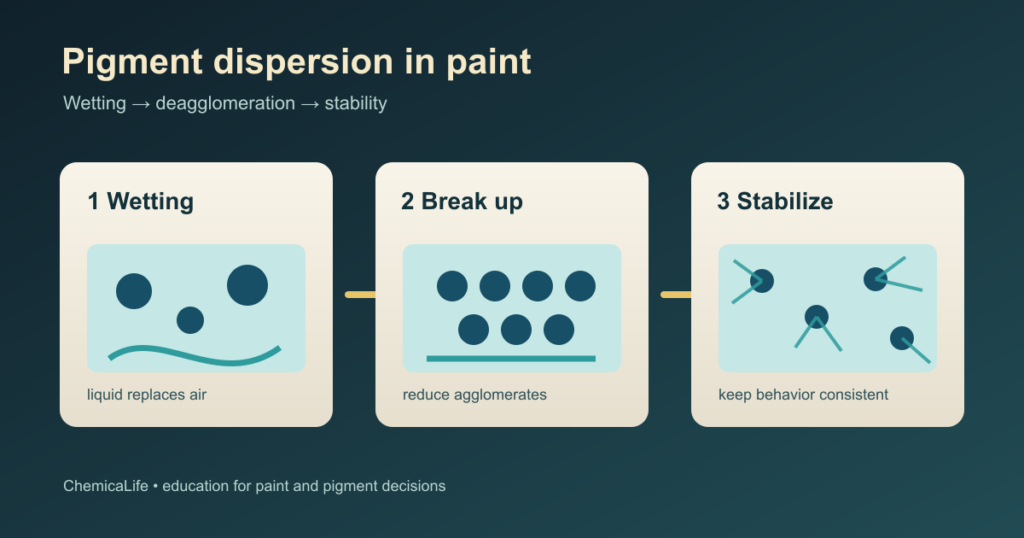
For pigment dispersion in paint, think of dispersion as a sequence rather than a single mixer setting. A dry pigment first has to contact the liquid, then its agglomerates must be reduced, and the separated particles must remain compatible with the surrounding binder, solvent or water, and additives. That sequence is why pigment chemistry is useful background, but it cannot replace a check on the actual paint.
What happens during pigment dispersion?
Dry pigment powder contains particles and clusters with air at their interfaces. Wetting replaces those interfaces with the liquid phase. Agitation then supplies energy that can break down the larger clusters. The final step is stabilization: the separated particles need enough repulsion, steric protection, or a suitable particle network to avoid immediately joining again.
These stages overlap, but they answer different questions. A coarse speck that is present in the first draw may point to incomplete dispersion or contamination. A shade or gloss change after storage raises a different question about stability. The visible symptom alone does not identify which stage failed.
Why pigment dispersion changes color and gloss
Particle arrangement changes how a wet coating scatters light. If clusters remain, the sample can show a different strength, undertone, gloss, or surface texture even though the formula contains the labeled amount of colorant. The effect depends on the pigment, vehicle, film thickness, substrate, and measurement method. Avoid treating a color mismatch as proof that the tinting machine added too little pigment.
Particle size also matters, but “smaller is always better” is not a safe rule. A target size distribution is chosen for the pigment and the application. A sample that passes an initial fineness check may still need a storage comparison, because the first test does not establish long-term stability. In one peer-reviewed study of a tested waterborne system, accelerated and storage separation did not answer exactly the same question.
Wetting, deagglomeration, and stabilization are different jobs
| Stage | Question to ask | What the observation does not prove |
|---|---|---|
| Wetting | Did the liquid replace air around the powder, or do dry pockets remain? | That all later clusters have been broken down. |
| Deagglomeration | Were the starting clusters reduced under the actual mixing conditions? | That the separated particles will remain stable in storage. |
| Stabilization | Do the pigment surface and liquid keep the particles apart or form a controlled network? | That a different paint base or additive will behave the same way. |
A pigment dispersant is one formulation tool; a professional discussion of dispersants describes electrostatic, steric, and combined stabilization mechanisms. The surrounding liquid matters: pH, dissolved ions, and the pigment surface can change how an additive behaves. That is why “add more dispersant” is not a universal troubleshooting instruction.
How dispersion differs from flocculation and settling
Dispersion describes how particles are introduced and maintained in the liquid. Pigment flocculation describes particles forming associations after or during that state. Settling describes movement under gravity. The three can appear in the same container, but a layer at the bottom does not by itself prove flocculation, and a smooth first draw does not prove that the system will stay unchanged.
When a sample changes, record the earliest point at which it departs from a known-good comparison: during wetting, immediately after mixing, after a rest period, or after storage. This simple time sequence is more useful than changing pigment amount, mixing time, and application thickness all at once.
What a fineness check can and cannot tell you
ASTM D1210 covers the fineness of dispersion of pigment and vehicle systems. A gauge or similar check can help compare coarse material under a defined method. It cannot, by itself, identify the chemistry of a defect or predict every storage outcome. If the result matters, keep the test method, sample history, temperature, and reading conditions with the record.
Optical microscopy can help a coatings laboratory investigate coarse or clustered material, especially when more than one pigment is present. It is an investigation aid, not a substitute for formulation history. Unfamiliar coatings should be sampled and tested by trained personnel following the product’s handling information.
A practical dispersion record for a paint sample
- Write down the pigment or tint identifier, base paint, batch numbers, and the date of mixing.
- Record the equipment, order of addition, mixing time, and any controlled temperature or rest period.
- Compare a labeled draw immediately after mixing with one after the planned storage interval.
- Describe the observation precisely: coarse specks, a bottom layer, shade shift, gloss change, or a difference only after application.
- Keep the original sample and a known-good comparison so a supplier or laboratory can see the starting state.
If the problem is that the background shows through the dry film, the next question may be paint hiding power, not dispersion alone. If the question is whether the colorant is a pigment or a dye, use the pigment-versus-dye comparison rather than inferring composition from one appearance.
Key takeaway
Good pigment dispersion is a controlled sequence of wetting, deagglomeration, and stabilization. Use a defined fineness check to compare samples, but keep storage behavior and application results in the same investigation. The most useful report states what changed, when it changed, and under which conditions—without treating one visual symptom as a complete diagnosis.