Evidence-based guide
Pigment vs Dye: Differences in Paint, Ink and Fabric
Quick answer: A pigment remains as solid particles in its application medium; a dye generally colors from a dissolved state during application. That distinction helps explain behavior, but it does not by itself prove better durability, waterproofing or printer compatibility.
If you are choosing replacement printer ink, start with the ink specified for your exact printer. This article explains the materials distinction; it is not a conversion guide for switching an ink system.
What is the difference at particle level?
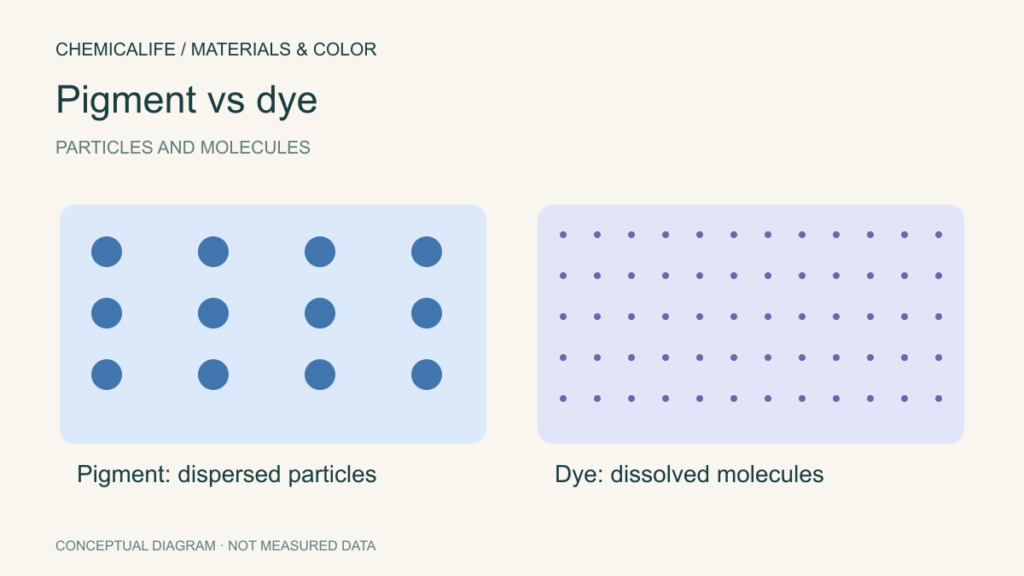
In a pigment dispersion, small solid particles are distributed through the liquid or solid carrier. In a dye solution, the colorant is dissolved on a molecular scale. Both can look uniformly colored to the naked eye, so appearance alone cannot reliably distinguish them.
A useful conceptual comparison is particles distributed through a binder versus molecules distributed through a solvent. It is not a literal comparison of particle sizes or a sedimentation test. A well-formulated pigment ink can remain evenly dispersed; a visible deposit is not necessary for an ink to be pigment-based.
| Check | Pigment | Dye |
|---|---|---|
| State during application | Dispersed solid particles | Generally dissolved during the relevant coloring process |
| How color stays in place | Often held by a binder or incorporated into the material | Depends on the dye, substrate and fixation process |
| Transparency | Can be transparent, translucent or opaque in a formulation | A dissolved dye can color a transparent medium |
| Durability | Requires evidence for the actual product | Requires evidence for the actual product |
Why “pigment does not dissolve in water” is incomplete
The medium and process matter. A dye need not dissolve in room-temperature water to function as a dye. The Colour Index introduction explains that some dye processes change the colorant’s solubility during application, and the same chemical constitution can sometimes serve as a dye or a pigment in different uses. This is why a home water test is not a universal identification method.
Paint, ink and fabric ask different questions
Paint: do you need to hide or reveal the background?
For an opaque painted finish, look for hiding performance in the finished product. For a glaze, transparency may be desirable. Do not assume that a pigment-based product must conceal the background: some pigment paints are intentionally transparent. Ask how the color looks in a thin, dried film on your intended surface.
Ink: what system will receive the color?
Separate three questions: whether the ink works in the device, whether the paper or coating receives it correctly, and whether the finished print meets the needed durability. A bottle labeled “pigment” answers none of those questions on its own. Use the equipment maker’s compatibility information and product-specific print testing.
Fabric: what fiber and fixation process are involved?
A fabric project needs a system matched to the fiber. Dyeing and pigment printing use different approaches to retaining color. Before beginning, identify whether the product is intended for dyeing, fabric painting or textile printing, then follow its fixation and washing directions. An intense initial color does not demonstrate washfastness.
A practical comparison worksheet
- Write down the exact job: an indoor illustration, a document, a wall or a washable textile.
- Identify the surface, fiber, paper or equipment model.
- Collect the product’s compatibility and application instructions.
- Separate the desired qualities: opacity, water resistance, washfastness and resistance to fading.
- Compare evidence for those qualities under the same conditions. If data are absent, mark them unknown.
Common questions
Are pigments always more lightfast than dyes?
No universal ranking follows from these two words. The particular colorant, concentration, medium and exposure affect performance. Use a rating or test for the actual product rather than substituting the material category for evidence.
Does “water-based” mean dye-based?
No. Water can carry dispersed pigment particles or dissolved ingredients. “Water-based” describes the carrier system, not a complete description of the colorant.
Is every colorant either permanently one or the other?
Not necessarily. Some classifications depend on the way a substance is used. The application process is part of the answer.
Explore the pigment chemistry guide for related explanations of color, opacity and durability.
Sources and editorial scope
- Society of Dyers and Colourists / Colour Index: An Introduction to Pigments
- Royal Talens: Opacity and transparency
- Li Yuanyuan, 颜料化学与工艺学 (Pigment Chemistry and Technology), Chemical Industry Press, 2020. ISBN 978-7-122-36005-2. Background reading: Chapter 2, pp. 9–16; Chapter 3, section 3.1.