Evidence-based guide
Illuminant Metamerism: Why Two Paint Colors Match, Then Differ
Illuminant metamerism occurs when two samples match in color under one light source but no longer match under another. In paint, this can happen when different pigment combinations produce similar appearances under the first light while reflecting different amounts of light across the visible spectrum. The key is the relationship between two samples: one wall looking warmer at night does not, by itself, establish metamerism.
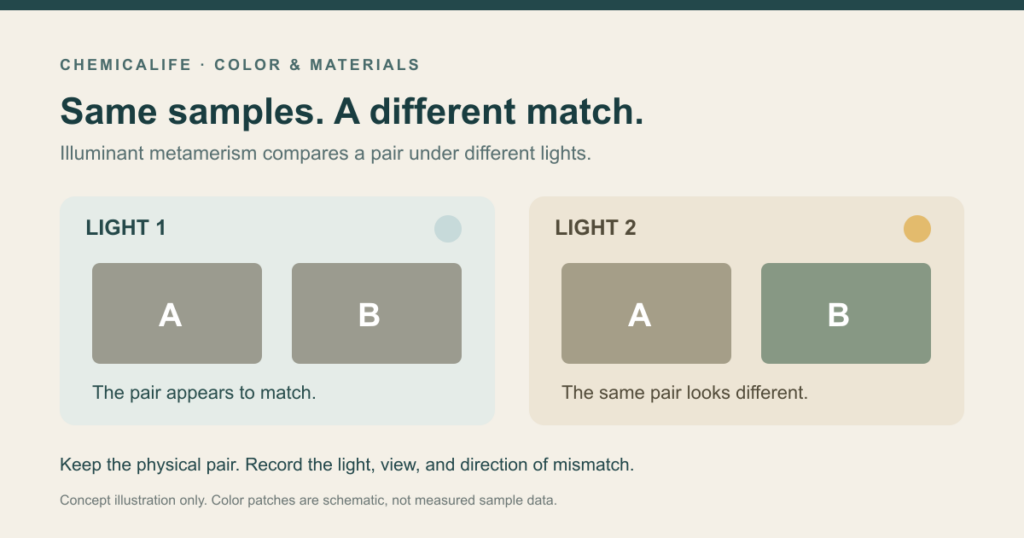
Imagine comparing a dried touch-up sample with a painted cabinet door. They appear alike near a window, but under the room’s evening lighting the sample looks slightly greener. Before adding more tint, compare the pair again under both conditions. A difference that depends on the light deserves a different investigation from a coating that has faded over several years.
Why a color match can fail under another light
A color match is made under particular viewing conditions. Two surfaces can reach that match without having the same spectral response. Changing the light’s spectral composition can then separate their appearances. The CIE explanation of metameric matches distinguishes this change of illuminant from observer metamerism, in which changing the observer can disrupt a match.
For a paint comparison, keep the same person looking at the same two samples while the illumination changes. That will not prove the cause, but it makes the observation easier to describe. Writing “sample B becomes greener than sample A under the kitchen fixture” is more informative than “this paint changes color.”
Metamerism examples—and observations that mean something else
| Observation | What to investigate | What you cannot conclude yet |
|---|---|---|
| Two dried paint samples match under one lamp but separate under another. | An illuminant-dependent mismatch; compare the pair under controlled conditions. | That the tint amount or pigment selection is definitely wrong. |
| One wall looks warmer when the room lighting changes. | The appearance of a single surface under different illumination. | That you have demonstrated a metameric pair. |
| A touch-up shows mainly as the viewing angle changes. | Differences in gloss, texture, or surface appearance. | That a change of illuminant caused the mismatch. |
| An exposed area differs from a protected area under the same light. | Exposure history and possible material changes, including fading. | That changing the lamp will restore the original coating. |
This table suggests questions, not diagnoses. Paint hiding power also deserves attention if the substrate shows through one sample more than the other. Two films over different backgrounds are a poor starting point for judging a close color match.
A useful first comparison with paint samples
Use physical samples that have dried as directed, and record which is the reference. These steps are an observation checklist, not a standardized laboratory test:
- Compare the pair side by side. Keep their positions, surrounding background, and viewing angle as consistent as practical. Note any obvious difference in sheen or texture.
- Start with the intended-use lighting. Record the room, fixture, and whether daylight is also entering. “The living room with curtains closed and the ceiling lights on” is a more specific description.
- Compare under a second lighting condition. Keep the samples together. Describe the direction of the mismatch rather than assigning a guessed numerical color difference.
- Return to the first condition. Record whether the earlier match returns. That observation helps separate an immediate lighting effect from a lasting change in the material.
- Retain both samples. Label the product and batch identifiers, application date, substrate, and coating build if known. Provide the pair when asking a supplier or laboratory for an assessment.
The aim is a short, usable record. For the cabinet example: “A and B look close under the window light; B looks greener under fixture 2; they look close again at the window.” Avoid changing tint quantity, film thickness, and lighting together, because the result will be harder to interpret.
What professional visual and instrument checks tell you
ASTM D4086 describes visual evaluation of illuminant and observer metamerism. Its public scope excludes gonioapparent samples—materials whose appearance changes with viewing or illumination geometry—and does not provide the calculation of metamerism indices from spectral measurements. Metallic and pearlescent finishes therefore need an assessment suited to their directional appearance.
A color-difference number also needs context. ASTM D2244 addresses calculations from measured color coordinates and calls for visual confirmation when samples may be metameric. A small Delta E under one set of conditions does not guarantee that the two surfaces will match under every light.
When requesting a measurement, ask which color-difference formula, illuminant, observer, and measurement geometry were used. Compare like with like. Do not adopt a universal “Delta E below this number is acceptable” rule from an unrelated job; the agreed appearance requirement and the specimens matter.
Can a phone photo show the problem?
A photograph can document the samples and the lighting arrangement, but keep the physical pair. A NIST study of digital-camera color errors found that camera technology, illumination spectra, and lighting uniformity affected the recorded colors. It examined specific capture conditions; it does not establish a fixed error for every modern phone.
Use the image to explain where you saw the mismatch, rather than treating a screen comparison as the final color decision. For a close match, ask the evaluator to inspect the actual samples under the relevant lights.
Is this the same as paint fading?
No. Switching lamps can change the match immediately without establishing that either coating has deteriorated. Light damage is a different process: the Canadian Conservation Institute’s guidance on paintings describes it as cumulative and irreversible. That conservation guidance explains the distinction; it is not a service-life estimate for wall paint.
If a sample remains different after you return to the same reference lighting, investigate its exposure and condition. Our lightfastness guide covers resistance to light-induced color change. If the liquid paint changed during mixing or storage, pigment flocculation is another, separate question.
For an illuminant-dependent mismatch, agree on the lights and physical reference samples that matter before approving a replacement. The pigment chemistry guide connects color matching with the other properties that influence a finished coating.