Evidence-based guide
Pigment Flocculation in Paint: What to Check Before Adding More Color
Pigment flocculation happens when dispersed pigment particles gather into clusters inside a liquid coating. The colorant may still be present in the correct amount, yet the paint can develop a different shade or lose gloss. A patchy finish alone does not prove flocculation: first separate a particle-stability problem from mixing, settling, and application problems.
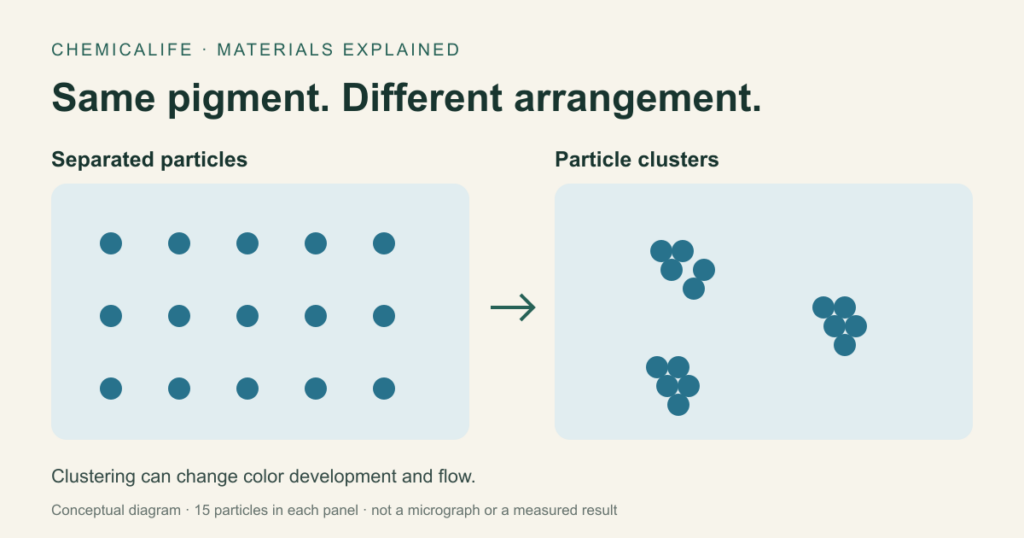
Imagine a paint counter dispensing the same blue tint into two cans of white base. Both receive the specified amount, but one dries paler. Adding more blue might hide the mismatch in that sample while leaving the underlying problem untouched. The useful question is when the difference appeared: during mixing, after storage, or only on the wall.
What changes when pigment particles flocculate?
The pigment does not need to dissolve or change chemical identity. Its arrangement changes: particles that were separate become associated. IUPAC defines flocculation in terms of particles forming aggregates in an unstable colloidal system. In paint, the practical concern is whether that changing arrangement affects the color, surface appearance, or flow. A visible defect still needs investigation; the definition is not a diagnosis of a particular can.
This distinction matters when comparing organic and inorganic pigments. A pigment family name cannot tell you whether a particular colorant will remain stable in your particular base paint.
Flocculation, settling, or incomplete dispersion?
Keep these observations separate before choosing a remedy:
| Observation | Question to investigate | What it does not establish |
|---|---|---|
| Coarse material is present from the first sample. | Were the original pigment clusters adequately broken down? Is there contamination? | That a previously stable dispersion has flocculated. |
| A layer collects at the bottom during storage. | How readily does it remix, and does the restored paint perform normally? | That all settling is caused by flocculation. |
| The shade changes after adding colorant to a base. | Are the base and colorant compatible under the actual mixing conditions? | That the dispensing machine added too little pigment. |
| One section of a dried wall looks different. | Were the substrate, film thickness, drying conditions, and application method consistent? | That the liquid paint had a dispersion defect. |
The table is a troubleshooting sequence, not a laboratory result. Several causes can coexist. For example, clusters may settle, but finding sediment does not identify how those particles became associated.
What does a pigment dispersant do?
A pigment dispersant helps maintain particle separation. Depending on the system, adsorbed molecules provide electrical repulsion, a polymer barrier, or both. The additive must work with the pigment surface and the surrounding liquid. A study of polymeric dispersants in waterborne coatings explains these mechanisms and shows why the surrounding liquid matters: its pH and dissolved ions can affect stabilization. A dispersant is therefore part of a formulation, not a universal cure for weak color.
Breaking up the starting pigment agglomerates and keeping the resulting dispersion stable are different tasks. A fresh paint can contain coarse material because dispersion was incomplete from the outset. That differs from material that initially looked satisfactory and changed during storage. Keep both possibilities open when describing the fault.
There is no useful universal instruction to “add more dispersant.” A suitable product and dose for one base may perform poorly in another. Finished retail paint should be discussed with its supplier before additives or extra water are introduced.
Can more mixing fix the color?
If a second mixing cycle appears to restore the expected color, record that result without calling the problem solved. You have observed the paint immediately after that cycle; you have not yet checked whether it will behave the same way after storage. Compare labeled samples made under the same application conditions instead of changing tint quantity and mixing time together.
A useful supplier report therefore records the base and tint product codes, batch numbers, tint amount, equipment, mixing duration, and the time between mixing and application. “It became paler after the second mixing cycle” gives a technician more to investigate than “the blue is weak.” Keep a labeled sample of the original material rather than changing the whole can repeatedly.
What laboratory checks can tell you
Microscopy can help a coatings laboratory examine whether pigment is clustered or incompletely dispersed. An American Coatings Association article on optical microscopy notes that both problems can coexist in a paint containing multiple pigments. This is one reason to provide a retained sample, not just a photograph of the wall. Leave sample preparation and testing of unfamiliar coatings to trained staff using the product’s handling instructions.
A grind gauge answers a different question. The public scope of ASTM D1210 describes assessment of dispersion fineness in liquid coatings. Passing a fineness check today cannot, by itself, demonstrate that the paint will keep the same shade after storage. An evaluation needs an appropriate storage comparison as well as the initial sample.
Is all flocculation undesirable?
No. Controlled flocculation can be used to form a particle network that slows sedimentation. In a study of dispersing agents in recycled waterborne paints, researchers assessed both accelerated instability and separation during storage; the tests did not always give the same ranking. That is a useful warning against judging a formulation by one observation alone. It is not a recommendation to make a finished paint flocculate, or to select an additive from this article.
For a practical next step, identify the earliest stage where the paint departs from a known-good sample, then ask the supplier to investigate that stage. If the color is consistent but the background still shows through, the separate issue may be paint hiding power. Our pigment chemistry guide connects these different properties without treating them as interchangeable.