Evidence-based guide
Organic vs Inorganic Pigments: What the Labels Really Mean
Quick answer: “Organic” and “inorganic” classify pigment chemistry. They do not mean natural versus synthetic, and they do not establish safety or performance. Choose by the specific pigment and finished product’s application data.
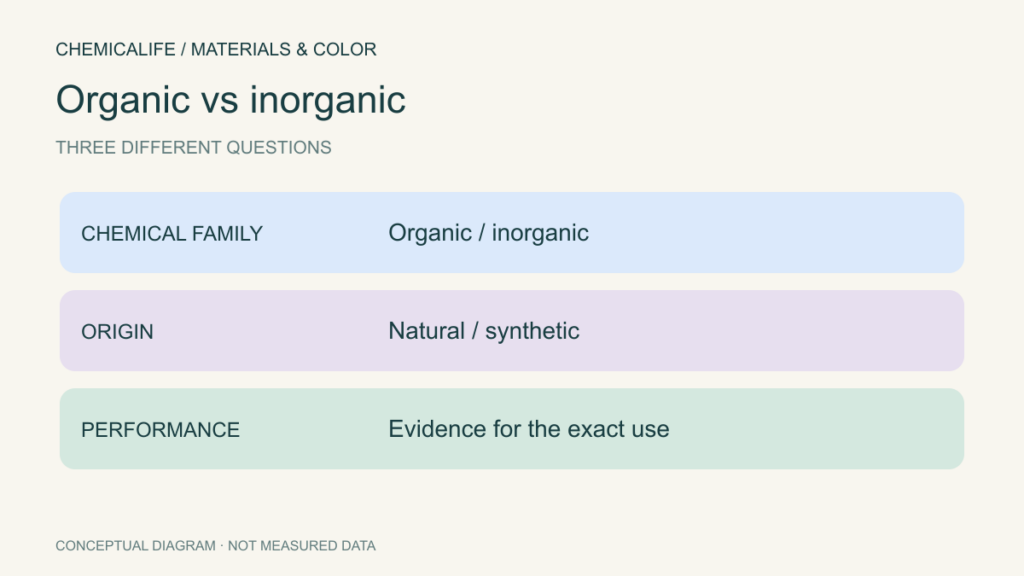
A label can tell you that a pigment belongs to a chemical family without telling you whether it will suit a mural, transparent glaze or plastic part. The most useful comparison separates chemical structure, manufacturing origin and measured behavior.
What do the two categories mean?
Organic pigment families are built around organic molecular structures; examples include azo pigments, phthalocyanines and quinacridones. Inorganic pigments include materials such as titanium dioxide and iron oxides. Some organic pigments contain metals, so “contains a metal” is not a complete classification rule.
Carbon content alone is also too crude a shortcut. Carbon black is a familiar boundary case: the Colour Index introduction discusses its characteristics across the organic/inorganic distinction. Use the recognized pigment identity and classification rather than trying to categorize an unfamiliar substance from one element.
| Label question | What it tells you | What it does not establish |
|---|---|---|
| Organic or inorganic? | Chemical family | Natural origin or suitability for body use |
| Natural or synthetic? | Source or manufacturing route | Purity, low hazard or superior durability |
| Transparent, lightfast or heat-stable? | A performance claim in a defined context | The same result in every binder, concentration or exposure |
Does organic mean plant-derived?
No. A synthetic organic pigment is still organic. A synthetic inorganic pigment is still inorganic. The word on a paint label is not equivalent to an organic food certification. If the origin matters to your project, ask the manufacturer about that separately instead of inferring it from the chemistry label.
Which family performs better?
There is no single winner because “better” can mean many things. A transparent color useful for glazing can be a poor choice for covering an old dark finish. A pigment suitable for an indoor artwork may not meet the heat conditions of a plastic process. The family narrows the conversation; it does not finish the specification.
Broad summaries sometimes describe organic pigments as vivid and inorganic pigments as opaque or durable. Treat those as tendencies with exceptions, not selection rules. Pigment grade, particle properties, binder and test conditions can change the result. Avoid publishing or relying on a two-column chart that awards a universal winner for safety, weathering or cost.
How to compare two actual paints
- Match the application. Compare products intended for the same surface and medium.
- Record identity. Note the color name, Colour Index code or codes, and manufacturer’s range.
- Check appearance. Compare opacity at a similar dry film thickness. For mixing, use the same base or white.
- Check durability separately. Look for the rating legend, test conditions and any limitations for washes or tints.
- Check the full product. Read its directions and safety information. The colorant is only one ingredient.
A worked decision example
Suppose you need a transparent blue layer over a drawing. “Organic” is not the acceptance criterion. The useful questions are whether the exact blue is labeled transparent, whether the binder works on the drawing surface, and whether the manufacturer provides suitable lightfastness evidence. For an opaque blue sign, the same pigment family could still be relevant, but hiding and exterior performance would need different evidence.
What this comparison cannot tell you
Neither category establishes that a material is suitable for food contact, cosmetics, tattooing or other body applications. Do not transfer an artist-paint classification into those uses. This guide discusses color materials, not approval of products for skin or ingestion.
Can one paint contain both categories?
Yes. A finished color may be a mixture. Read all pigment codes listed, and evaluate the complete paint instead of assuming the first named pigment describes every ingredient.
Will the same pigment code mean identical paint?
No. It helps identify the colorant, but it is not a recipe for the complete product. Compare the formulation’s published properties and a suitable sample.
Explore the pigment chemistry guide for related explanations of color, opacity and durability.
Sources and editorial scope
- Color Pigment Manufacturers Association: Pigment FAQs
- Society of Dyers and Colourists / Colour Index: An Introduction to Pigments
- GOLDEN: Technical chart and lightfastness definitions
- Li Yuanyuan, 颜料化学与工艺学 (Pigment Chemistry and Technology), Chemical Industry Press, 2020. ISBN 978-7-122-36005-2. Background reading: Chapter 2, pp. 10–16; Chapter 3, section 3.1.