Evidence-based guide
Paint Chalking: Causes, Look-Alikes and What to Check
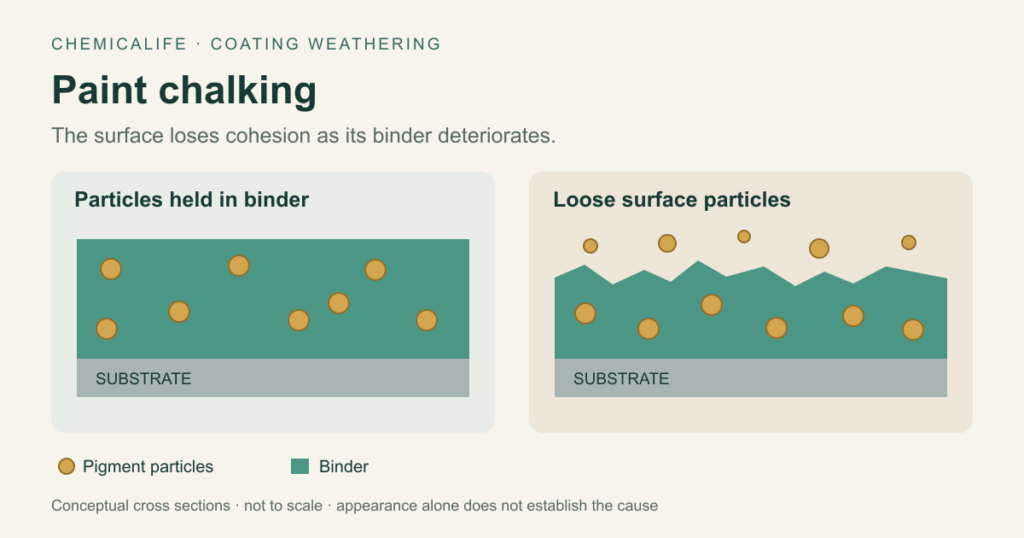
Paint chalking is the formation of loose powder at a coating’s surface as its binder deteriorates. In weathered exterior paint, the resin that holds the pigment particles together gradually breaks down, leaving a surface that sheds fine material. The powder is a clue about the coating’s condition, but its color alone cannot identify the cause.
If an exterior wall looks pale or dusty, separate three questions: is there loose material, is the paint still attached, and has the color changed? Calling all three “fading” can hide a useful distinction. Calling every white deposit “chalking” can send you toward the wrong repair.
What causes paint chalking?
Two relevant factors are the coating’s formulation and its exposure. The National Park Service’s guide to exterior paint problems describes resin deterioration and ultraviolet exposure as part of the explanation. It also notes that excessive powder can wash onto surfaces below and leave streaks. Its discussion concerns exterior woodwork; it is not a diagnosis of every dusty interior wall.
The pigment and binder have different jobs. Pigment contributes color and other optical properties; binder holds the coating together. A durable pigment does not, by itself, establish that the complete paint film will remain sound outdoors. The condition of the film matters as well as the colorant.
For that reason, a lightfastness rating does not answer the whole weathering question. Our guide to lightfastness explains the color-retention side. When investigating chalking, also ask what is happening to the material that binds the particles into a film.
Chalking, fading, peeling or a salt deposit?
Use these descriptions to organize observations, not to declare a diagnosis from a photograph.
| Observation | What the term describes | What remains unresolved |
|---|---|---|
| Chalking | Loose fine material generated by deterioration at the paint surface | Its extent, the coating’s remaining condition and the appropriate preparation |
| Fading | A loss or change of apparent color | Whether loose powder, pigment change or another surface condition is also present |
| Peeling | Paint separating in flakes or sheets | Which interface has lost adhesion and whether moisture is involved |
| Efflorescence | A deposit of soluble salts on masonry | Where the salts and moisture came from |
| Adhering dirt | Material deposited on the coating from elsewhere | Whether the coating itself is degrading underneath it |
These conditions can overlap. A painted surface can look faded and also be chalking; another can have powder in one area and peeling at an edge. Recording both observations is more useful than choosing one label for the entire wall.
On brick, concrete or other masonry, a pale deposit deserves particular care in interpretation. The National Park Service’s masonry glossary describes efflorescence as soluble salts appearing at the surface. That is a different process from deterioration of paint resin. A coating over masonry does not remove the need to consider the substrate and water movement.
A practical example: two pale patches, two different questions
Imagine a house with a dusty-looking area on painted wood siding and a white patch on nearby brick. This is a hypothetical observation, not a test result.
For the siding, useful records include its repainting date, which side faces the sun, whether the patch sits below a runoff path, and whether flakes are visible. For the brick, record whether the deposit crosses unpainted areas or mortar joints and whether damp marks are nearby. Neither set of notes proves a cause. They help a contractor or conservator decide what needs closer examination.
Now suppose an old photograph makes the siding look darker. That does not measure a chalking rate: lighting, camera exposure and the surface’s condition were not controlled. Keep the photograph as context, while describing what is actually visible today. “A pale area below the sill, with small flakes at the corner” is a clearer starting point than “the pigment has failed.”
What to record before disturbing the surface
You can prepare a useful inspection note without creating a powder sample:
- Identify the material. Record whether the surface is painted wood, masonry, metal or something else.
- Find the history. Note the building’s age and any known coating or repainting dates. Mark unknown details as unknown.
- Map the location. From a safe position, photograph the affected area and a wider view showing its surroundings.
- Record accompanying changes. Note visible peeling, cracks, streaks, damp marks or deposits on adjacent materials.
- Separate observations from conclusions. Write what you saw and which cause is still a question.
Do not create dust by rubbing, scraping or sanding unknown old paint just to see whether it is chalky. For US homes built before 1978, EPA’s guidance for renovation and painting explains the risk of lead-containing dust and chips and recommends a lead-safe certified contractor. Establish the paint history and appropriate precautions before any work that disturbs it.
What does a chalking test report tell you?
Formal assessment adds a defined method and reference scale to the observation. ISO 4628-6:2023 describes assessment of chalking using a tape method and pictorial references. Its public abstract specifically warns that adhering dirt must be distinguished from degradation products, especially when the effect is slight.
That does not make an improvised household tape test equivalent to a standard assessment. If a supplier or laboratory reports a chalking result, ask for the method and edition, the reference scale, the exposure conditions and the time at which the result was taken. A number without that context is hard to compare with another report.
Keep the claim narrow, too. A chalking assessment describes this aspect of surface deterioration; it does not identify every chemical in the deposit or establish the complete coating’s remaining service life.
Can you just paint over a chalky surface?
A new coat does not answer why material is loose or whether the layer beneath it is sound. Before choosing a repainting system, the assessment needs to establish what the deposit is, which existing layers are attached, and whether a moisture problem also needs attention. The NPS guidance treats surface condition and adhesion as part of repainting preparation.
Ask for a proposed treatment that names the substrate and the finding it addresses. For example, “prepare this weathered coating for adhesion” and “investigate recurring salts on this masonry” describe different jobs. A product recommendation made before that distinction is settled leaves an important question unanswered.
For the broader material roles behind this problem, see what pigments are used for and the pigment chemistry guide. Keep color retention, surface powdering and adhesion as separate observations when comparing an aging coating.
Textbook context: Li Yuanyuan, 颜料化学与工艺学 (Pigment Chemistry and Technology), Chemical Industry Press, 2020, chapter 2, section 2.5.3, p. 16, discusses weather, light and heat resistance. The house example above is original and hypothetical; it is not a field diagnosis.