Evidence-based guide
Pigment Volume Concentration: A Worked Paint Calculation
Pigment volume concentration (PVC) describes how much of a coating’s nonvolatile volume comes from pigments and extenders. It is a volume percentage, not the pigment’s share of the wet paint’s weight. To calculate it from a recipe, first convert each dry ingredient’s mass into a volume using its material density, then compare the pigment and extender volume with the total nonvolatile volume.
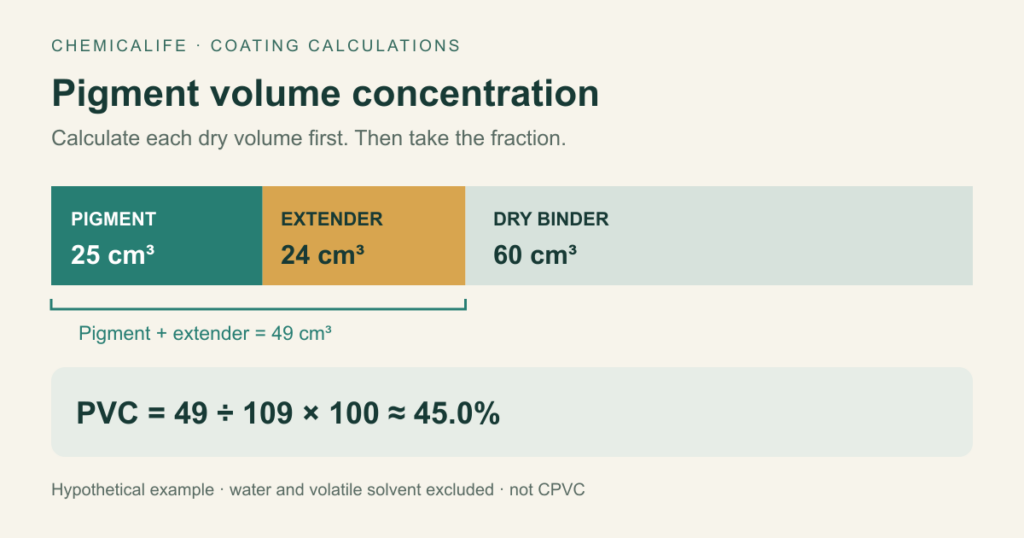
A useful way to read a PVC number is to ask what went into the denominator. Did the calculation use dry binder or the whole liquid binder dispersion? Were extenders included? Were powder-bed volumes mistaken for solid volumes? Those choices can change the answer even when the spreadsheet arithmetic is correct.
What belongs in the PVC calculation?
For a simplified paint containing only pigment, extender and binder as its nonvolatile ingredients, use:
PVC (%) = 100 × (pigment volume + extender volume) ÷ (pigment volume + extender volume + dry binder volume).
The Polymer Science Learning Center’s PVC explanation sets out the pigment-to-pigment-plus-nonvolatile-binder relationship. Here, we show the extender separately so that a filler is not accidentally left out because it contributes little color.
| Ingredient | How this example treats it |
|---|---|
| Color or white pigment | Include its solid volume in both numerator and denominator. |
| Extender or filler | Include its solid volume in both numerator and denominator. |
| Dry binder | Include its volume in the denominator. |
| Water or volatile solvent | Exclude it from both sides of this dry-solids calculation. |
A real formula can contain other nonvolatile ingredients. Identify what each contributes and document the calculation convention rather than forcing every additive into the solvent column. The three-component formula above is deliberately limited to the example below.
A worked calculation from grams to solid volume
Consider an invented recipe with the following dry ingredients. All masses and densities are teaching values, not measurements of commercial grades. Assume nonporous solids and a suitable true material density for each component.
Use volume = mass ÷ density. This is a rearrangement of the density relationship explained by OpenStax. With grams and g/cm³, the result is cm³; one cm³ equals one mL.
| Dry component | Mass | Density | Calculated solid volume |
|---|---|---|---|
| Pigment | 100 g | 4.0 g/cm³ | 100 ÷ 4.0 = 25 cm³ |
| Extender | 60 g | 2.5 g/cm³ | 60 ÷ 2.5 = 24 cm³ |
| Binder solids | 66 g | 1.1 g/cm³ | 66 ÷ 1.1 = 60 cm³ |
- Add the particles: 25 + 24 = 49 cm³ of pigment and extender.
- Add all three dry components: 49 + 60 = 109 cm³.
- Take the volume fraction: 49 ÷ 109 × 100 = approximately 45.0% PVC.
Compare that with the dry mass fraction: (100 + 60) ÷ (100 + 60 + 66) × 100 = about 70.8%. Both calculations use the same recipe, but they answer different questions. Calling the 70.8% result “PVC” would confuse mass with volume.
This is a formulation calculation based on the stated component volumes. It is not a measurement of the finished film’s pores or a guarantee that every volume remains additive during drying.
What if the binder arrives as a liquid dispersion?
Suppose the example uses 132 g of a binder dispersion with 50% binder solids by mass. Assume, specifically for this example, that its entire nonvolatile fraction is binder. The dry binder contribution is 132 × 0.50 = 66 g. Divide those 66 g by the dry binder density of 1.1 g/cm³ to obtain the 60 cm³ used above.
Do not divide the full 132 g by the dry binder density. That would count the liquid carrier as if it were dry polymer. Likewise, the dispersion’s wet density and the dry polymer’s density describe different materials; one cannot silently replace the other.
Adding water while keeping all dry ingredient amounts unchanged does not change this calculated PVC. It changes the wet mixture. Adding more dry binder, by contrast, changes the denominator. Keep the recipe basis beside the calculation so that someone reviewing it can tell which operation occurred.
PVC, volume solids and pigment-to-binder ratio
These labels are easy to mix up because each describes a proportion. Write down what is being compared before copying a percentage from a data sheet.
- PVC: the pigment and extender share of the nonvolatile volume.
- Volume solids: the volume of material remaining after drying relative to the wet coating volume, under the stated method and conditions.
- Pigment-to-binder ratio: a ratio that needs an explicit mass or volume basis, plus a statement of whether extenders are included.
A Chalmers University study of binder content discusses PVC and volume solids separately in sections 2.3 and 2.4. Its discussion also notes limitations of a calculated PVC, including binder shrinkage during drying. For this example, knowing 45.0% PVC alone is not enough to calculate the wet coating’s volume solids.
If a pigment-to-binder ratio is reported without units or a basis, ask for clarification. In our example, the combined pigment-and-extender to binder ratio is 160:66 by mass and 49:60 by calculated solid volume. Neither ratio should be copied directly into a PVC percentage field.
PVC is not critical pigment volume concentration
Critical pigment volume concentration (CPVC) refers to a packing-and-binder threshold, not another name for the PVC you just calculated. The physical picture is a particle structure with just enough binder to fill its interparticle space. Above that threshold, unfilled spaces can remain in the dried coating.
A study in the Journal of the American Institute for Conservation explains how crossing CPVC is associated with void formation and changes in paint properties. That distinction matters: a calculated PVC of 45.0% does not establish that the example is below, at or above its CPVC. We have not measured or independently established that threshold for this hypothetical mixture.
Nor does a higher PVC automatically mean better color strength or better coverage. Those need their own comparisons. See how tinting strength is compared for color development and how paint hiding power is evaluated for coverage. A formulation percentage helps describe the sample; it does not replace those tests.
Check these inputs before trusting the result
- Use dry amounts. Separate binder solids from a dispersion’s carrier, and check whether a solids figure is by mass or by volume.
- Use the right density. A loose or tapped powder-bed density includes spaces between particles. It does not supply the solid-material volume needed for this calculation.
- Keep extenders in view. A colorless filler still occupies volume; removing it from the numerator changes the meaning of the result.
- State the scope. List any other nonvolatile components and explain their treatment. Do not present a simplified formula as a complete accounting of an undisclosed recipe.
- Keep the evidence. Record the ingredient grade, source of each density, solids basis and calculation date. If an input is missing, mark the result incomplete rather than filling the cell with an unrelated value.
For porous or surface-treated grades, establish which density value is appropriate before treating a handbook figure as exact. The example’s nonporous assumption makes its arithmetic straightforward; an unfamiliar real material deserves that extra check. Return to the pigment chemistry guide to place this calculation alongside the other properties used to describe a pigment.
Textbook background: Li Yuanyuan, 颜料化学与工艺学 (Pigment Chemistry and Technology), Chemical Industry Press, 2020, chapter 2, section 2.4.4, p. 15. The recipe and numerical comparisons in this article are hypothetical teaching examples.