Evidence-based guide
True Density vs Bulk Density: A Pigment Example
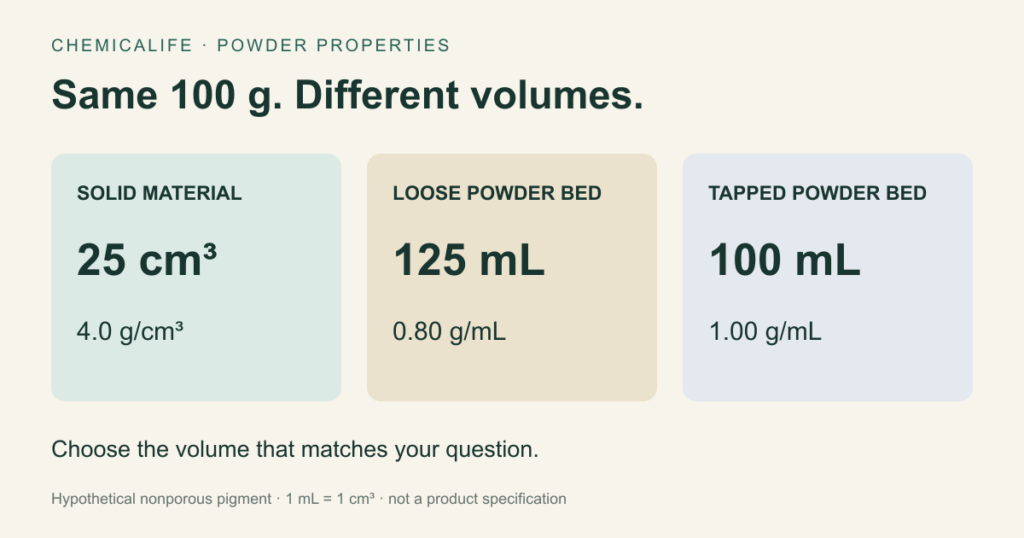
True density and bulk density use different volumes. True density refers to the solid material itself, excluding pores and spaces between particles. Bulk density uses the space occupied by a powder bed, including the gaps between its particles. For a pigment, those numbers answer different questions: how much solid material goes into a formulation, or how much room the powder needs in a container.
Suppose two bags each contain 1 kg of the same pigment. One bag looks fuller. That alone does not show that it contains more pigment or a weaker colorant. The powder may simply be packed more loosely. Before comparing the supplier’s numbers, read the words beside “density” and ask which volume was measured.
True density vs bulk density: compare the volume first
Density is mass divided by volume. The ambiguity lies in what the volume includes. A pile of powder contains solid material, spaces between particles, and sometimes pores within the particles. Different measurements count different parts of that space.
| Quantity | What its volume includes | Question it helps answer |
|---|---|---|
| True density | The solid material, with both pores and spaces between particles excluded | What volume does the solid material itself represent? |
| Skeletal density | The particle skeleton and inaccessible closed pores; accessible open pores and spaces between particles are excluded | What volume does a specified displacement measurement detect? |
| Loose bulk density | The powder bed, including spaces left by the filling procedure | How much powder occupies a given container volume under those conditions? |
| Tapped density | The powder bed after a defined tapping procedure | How much volume remains after that controlled settling? |
A DOE-hosted technical guide to material density distinguishes true, skeletal and bulk density by which pores and spaces are counted. A supplier may use “true density” more loosely for a gas-pycnometer result. Ask for the method and its treatment of pores before assuming that two labels describe identical measurements.
A worked pigment example: one mass, three volumes
The following values are invented for teaching. Assume a nonporous pigment with a solid-material density of 4.0 g/cm³. A 100 g sample occupies 125 mL when loosely filled and 100 mL after a specified tapping procedure. These are not measurements of a named product.
- Solid-material volume: 100 ÷ 4.0 = 25 cm³.
- Loose bulk density: 100 ÷ 125 = 0.80 g/mL.
- Tapped density: 100 ÷ 100 = 1.00 g/mL.
Because 1 mL equals 1 cm³, all three calculations use compatible units. The sample still weighs 100 g after tapping. Its measured bed volume has decreased as the particles pack more closely; the calculation does not say that the solid itself has become denser.
Now imagine dividing 100 g by the loose bulk density to estimate the solid volume in a paint formula. You would enter 125 mL instead of 25 mL, a fivefold difference in this example. The arithmetic is valid, but it answers the container-space question. Choosing the wrong kind of density caused the error.
Which density should you use for pigments?
For a storage or filling estimate, start with a bulk-density measurement that matches the handling state. A loose-fill result and a tapped result should not be swapped without explanation. In the invented example, 10 kg would occupy 12.5 L at 0.80 kg/L or 10 L at 1.00 kg/L. That is the powder-bed volume only; a container choice also needs room for filling and handling.
For a formulation expressed by solid volume, use the appropriate material-density value and method for each ingredient, not the loose volume of the bag. Chapter 2, section 2.4.4 of Pigment Chemistry and Technology makes this distinction when discussing density and specific volume. For porous or surface-treated grades, confirm the appropriate value with the supplier instead of silently substituting a handbook number.
For a color or coverage comparison, density alone will not settle the question. A heavier scoop is not a test of color strength. Compare the actual application and sample preparation; our guide to paint hiding power explains why a dried coating matters when judging coverage.
What should a supplier report tell you?
A useful report lets another reader understand how the number was obtained. Before replacing one grade with another, check:
- Material identity: grade, batch and whether the result describes dry pigment, a dispersion or a finished paint.
- Density type and units: loose bulk, tapped, skeletal or another explicitly defined result.
- Test method: the named procedure, instrument or standard, with any deviations stated.
- Sample condition: preparation, moisture condition and relevant temperature.
- For bulk measurements: the filling or tapping procedure and its endpoint.
- Meaning of the value: a typical data-sheet figure, a batch result or an agreed specification limit.
There are separate pigment standards for different tasks. ISO 787-10:1993 covers density determination using a pyknometer. ISO 787-11:1981 covers tamped volume and apparent density after tamping. These links point to public catalog descriptions, not a reproduction of the full laboratory procedures. Citing one standard does not make its result interchangeable with the other.
For example, a buyer receives “density: 1.2” from one supplier and “tapped density: 0.9 g/mL” from another. There is not enough information to rank the two powders. Ask the first supplier for the units and method, then compare like with like. Do that before changing a feed setting or calculating a replacement amount.
Why can bulk density change without a change in pigment chemistry?
Powder particles do not always pack the same way. Their arrangement and the filling conditions affect the amount of empty space in a bed. Tapping is one controlled way to investigate a change in packing; ISO 787-11:1981 describes a pigment test for tamped volume and apparent density after tamping.
If two deliveries fill different volumes, keep the batch labels and compare reports made using the same procedure. The observation is worth investigating, but it does not by itself prove contamination, poor color strength or a different chemical composition. Likewise, closely matching density values do not establish that two grades will produce the same paint.
Is specific gravity the same as density?
Specific gravity, also called relative density, is a ratio to a reference density and has no units; see the IUPAC definition of relative density. Density has units such as g/cm³. When water is the reference, the numerical values can look similar in common units; that does not remove the need to state the reference and conditions. Neither label tells you automatically whether a powder measurement included the spaces between particles.
Keep the complete description with every number you copy into a spreadsheet. “0.80 g/mL, loose bulk, specified fill method” is much more useful than a column headed only “density.” For the wider application context, see what pigments are used for and the pigment chemistry guide.
Textbook background: Li Yuanyuan, 颜料化学与工艺学 (Pigment Chemistry and Technology), Chemical Industry Press, 2020, chapter 2, section 2.4.4, p. 15. All numerical examples above are hypothetical, not product specifications or laboratory results.