Evidence-based guide
Rutile vs Anatase: What the Difference Means for Paint
Rutile and anatase are crystal forms of titanium dioxide, TiO2. Both can be made into white pigments. For paint that must hide a background and withstand outdoor exposure, rutile is generally the more suitable starting point. Anatase also has pigment uses, but a claim that it is “more active” in photocatalysis does not mean it makes a better protective paint.
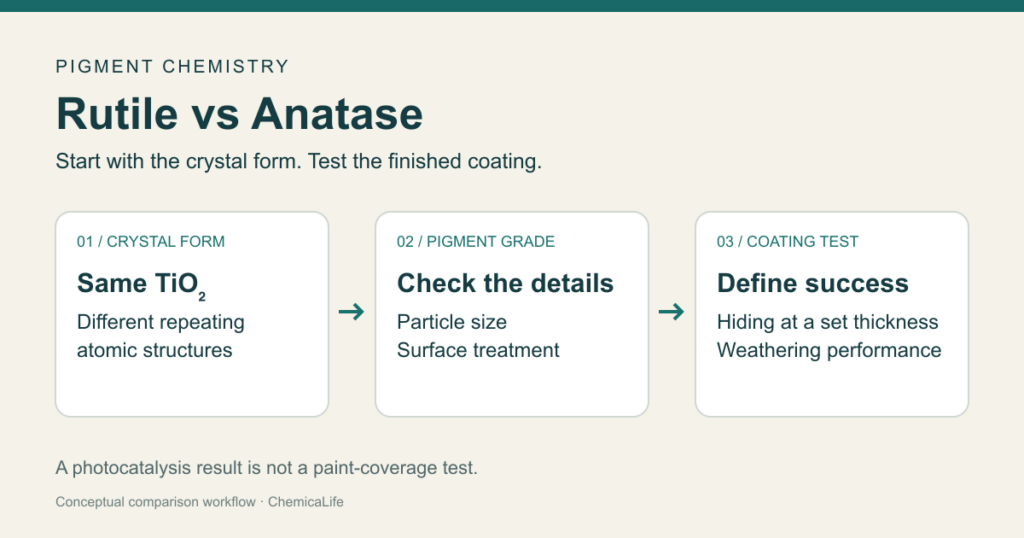
Two bags can both say titanium dioxide while supplying materials intended for different jobs. Before comparing rutile vs anatase, decide what you want the material to do: make a coating opaque, or help drive a light-induced chemical reaction. Those are different tests with different definitions of success.
Same formula, different arrangement of atoms
A chemical formula gives the ratio of elements. It does not specify every detail of their arrangement in a solid. Rutile and anatase are polymorphs: their titanium and oxygen atoms form different repeating crystal structures. The ChemTube3D models of both structures show them in terms of linked TiO6 octahedra.
That distinction helps when reading a specification. “TiO2 content” and “rutile content” are answering different questions: one concerns chemical composition, the other crystal phase. Neither line, on its own, describes a complete pigment grade. Keep phase identification separate from particle dimensions, surface treatment and the way the material is supplied.
| Question | Rutile | Anatase |
|---|---|---|
| Is the chemical formula different? | TiO2 | TiO2 |
| Can it be a white pigment? | Yes | Yes |
| What is the usual paint advantage? | Higher hiding power and better weathering performance | Do not assume equivalent outdoor performance from whiteness alone |
| Does the phase name specify the finished paint? | No; obtain grade and coating data | No; obtain grade and coating data |
The paint comparison above follows the Museum of Fine Arts Boston’s CAMEO entry on titanium dioxide pigments. It is a general comparison, not a test result for two particular products.
Why rutile titanium dioxide is a useful starting point for paint
A white powder in a bag is not the final object you are judging. The practical question is whether a specified coating hides its substrate at the thickness you will apply. Our guide to titanium dioxide in paint explains that broader pigment role.
For a comparison panel, record the substrate, wet application method and dry film thickness. Examine both a light and a dark area under the same lighting. A result described only as “looks whiter” leaves too much unresolved: are you comparing color, background visibility, or a glossy surface reflection? For the background question, use a defined hiding-power comparison.
Outdoor durability needs a separate check. CAMEO notes that both phases are photoactive, that rutile is less prone to photoreactivity, and that pigment coatings and stabilizing additions can reduce this activity. A rutile label therefore does not replace weathering evidence for the actual grade and paint system.
Photocatalytic activity answers another question
In photocatalysis, light helps drive chemical reactions at a material’s surface. A 2015 study by Kakuma and colleagues compared reactive oxygen species generated by rutile and anatase in water. Anatase generated hydroxyl radicals more readily under the studied conditions, while rutile generated superoxide faster. Adding hydrogen peroxide also changed the hydroxyl-radical response.
That result is useful because it prevents a single “activity” label from doing too much work. Ask which reaction was measured, in what medium and under what illumination. A result from particles suspended in water does not directly measure the coverage or lifetime of a dried paint film. If a specification highlights photocatalytic performance, request the associated test conditions before treating it as evidence for your application.
A fair comparison starts with a written question
Here is a hypothetical evaluation, not a report of laboratory results. You have one rutile grade and one anatase grade, and want to compare them in a white coating. Write down which of these questions you are testing:
- Can one replace the other in an existing recipe? Keep the agreed production recipe and application procedure as the baseline. Record any extra dispersant, mixing or other adjustment needed for the replacement. Those adjustments belong in the result.
- How do the grades compare at equal pigment volume? Define that basis before preparing panels. Equal masses do not establish equal solid volumes. Use suitable material-density data and calculate the pigment volume concentration for each formulation.
- Which finished formulation meets the requirement? Allow documented optimization for each grade, then compare against the same acceptance criteria. This evaluates complete formulations; it does not isolate the effect of crystal phase.
Do not switch between those questions halfway through the comparison. If you change the binder, pigment loading and dispersion method together, an improved panel cannot tell you which change produced the improvement.
For each panel, keep a short record: material identity, phase information, surface treatment if disclosed, batch recipe, preparation method, substrate, thickness, conditioning, lighting and observations. If weathering matters, add the exposure method and the changes you will measure. Set the acceptance criteria before looking at the results.
What to ask when the data sheet only says “TiO2”
- Does the document identify rutile, anatase or a mixture?
- Is this material intended as an opaque pigment or for another function?
- What particle-size and surface-treatment information is available for this grade?
- Are the reported coverage and weathering results tied to a stated formulation and test method?
- Can the sample be compared with your current material using the same documented procedure?
An unanswered question is a reason to request data, not to fill in a specification from a generic comparison chart. Use the phase name to narrow the investigation, then judge the supplied grade in the coating you actually need. For related explanations of pigment properties and applications, return to the pigment chemistry guide.