Evidence-based guide
Titanium Dioxide in Paint: Whiteness, Opacity and Limitations
Quick answer: Titanium dioxide (TiO₂) is used in paint mainly because pigment-grade particles scatter visible light efficiently, helping create whiteness and opacity. The ingredient alone does not determine coverage, durability or whether a finished coating suits your project.
You may see titanium dioxide on a paint information sheet or PW6 on an artist’s paint label. Those names help identify the white colorant. They are not a complete specification for the product in the can.
Why does it make paint look white?
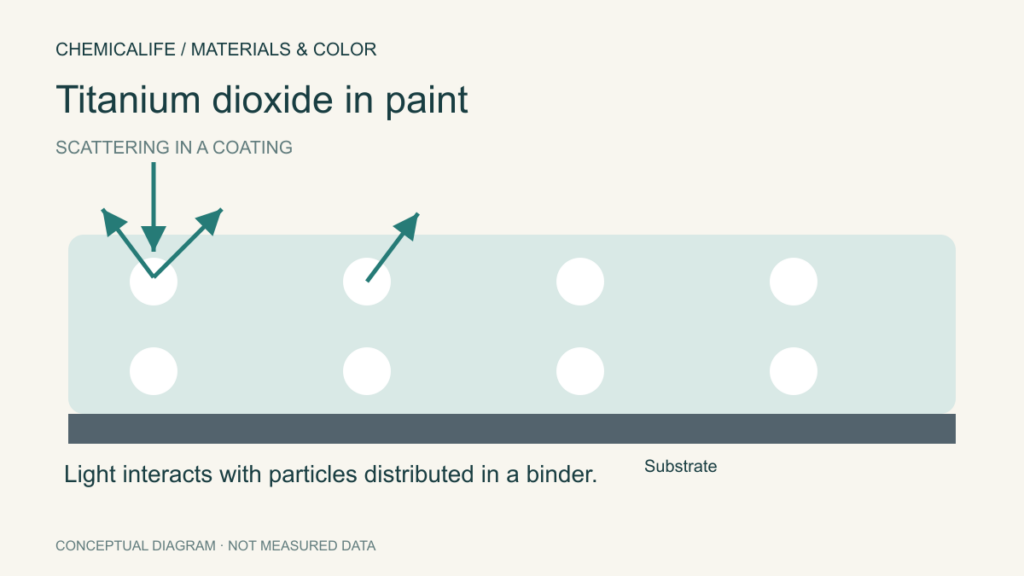
A white coating sends back a broad range of visible wavelengths rather than strongly favoring one narrow color band. TiO₂ particles have useful light-scattering properties when distributed in a suitable binder. The optical contrast between particle and surrounding material helps explain why a small solid particle can affect the appearance of an entire film.
Whiteness and hiding are related but distinct questions. A thin white film may still let a dark background show through. A thick white sample on a display card therefore does not tell you exactly how a normal coat will look on your wall.
Why pigment grade matters
Chemours identifies rutile and anatase as commercial TiO₂ crystal forms and explains why rutile grades are favored in many coatings. Its coatings information also describes surface treatments used to adjust dispersion and durability. Two materials bearing the same chemical formula can therefore be designed for different performance requirements.
For a reader choosing finished paint, the practical consequence is simple: do not treat a generic TiO₂ specification as equivalent to a coating’s application data. The relevant evidence belongs to the complete product and its intended use.
| Information available | Reasonable conclusion | Still unknown |
|---|---|---|
| TiO₂ is listed | The formula includes this ingredient | How well the dry film hides |
| PW6 appears on an artist label | Titanium white pigment is identified | The full binder and additive recipe |
| A pigment grade has durability data | That grade was evaluated under stated conditions | The finished paint’s exterior service life |
| A paint has a tested coverage claim | There is product-specific evidence to examine | Whether your surface matches the test conditions |
Why more TiO₂ is not a complete quality score
A coating needs pigment distributed through a functioning film. The amount of pigment is only one variable alongside dispersion, binder, other solids and film thickness. More of one ingredient cannot compensate automatically for every other weakness. Nor does a higher ingredient percentage tell you how many coats your particular color change will need.
For example, comparing two white paints by an ingredient list alone leaves several unanswered questions: were the films equally thick, were both applied over the same primer, and were the results assessed after drying? Those controls make the comparison more informative than guessing quality from a single chemical name.
TiO₂ is not the binder
The binder forms the continuous film that holds the coating together and attaches it to a suitable surface. Pigment influences appearance, but an opaque film still needs appropriate adhesion and durability. When paint fails, knowing that it contains titanium dioxide does not diagnose whether the problem came from preparation, application, the environment or the coating system.
Questions to ask before choosing a paint
- Is this exact product intended for the surface and indoor or outdoor exposure?
- What primer and preparation does the manufacturer specify?
- What are the spreading rate, film build and recoat instructions?
- Does the performance claim apply to the selected tint or base?
- Is there a sample or product-specific test that addresses the result I need?
Can I add titanium dioxide powder myself?
This guide is not a powder-handling or paint-formulation recipe. Adding raw pigment changes the material and does not guarantee better hide. Follow the finished product’s directions and use the manufacturer’s supported tinting or formulation options. Suitability for paint also does not establish suitability for food, cosmetics or another application.
Does a TiO₂ listing prove one-coat coverage?
No. Look for a claim and conditions for the finished paint, then consider the actual background and application. The chemical identity is only the starting point.
Explore the pigment chemistry guide for related explanations of color, opacity and durability.
Sources and editorial scope
- Chemours Ti-Pure: Titanium dioxide for coatings
- GOLDEN: Acrylic label information
- Li Yuanyuan, 颜料化学与工艺学 (Pigment Chemistry and Technology), Chemical Industry Press, 2020. ISBN 978-7-122-36005-2. Background reading: Chapter 2, section 2.2; Chapter 4, section 4.2.1, beginning p. 153.