Evidence-based guide
5 Household Cleaning Products You Should Never Mix
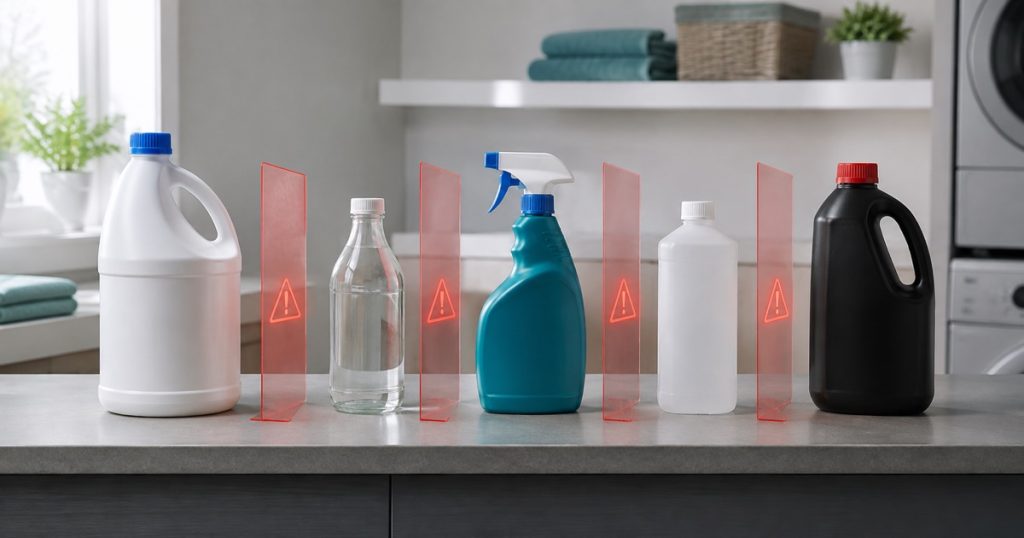
Short answer: never mix household cleaning products unless both product labels explicitly direct you to do so. Bleach deserves special caution: the CDC says household bleach and disinfectants should never be mixed with other cleaners or disinfectants because dangerous vapors can result.
A stubborn stain is a reason to reassess the cleaner and surface, not to combine bottles. Depending on their ingredients, two cleaners may react dangerously or interfere with each other instead of removing the stain. Product names are also unreliable clues: a glass, toilet, mildew, or multipurpose cleaner may contain an acid, ammonia, bleach, or another reactive ingredient.
The safest household rule is simple: use one product at a time, follow its label, ventilate the area, and keep every product in its original labeled container.
Household cleaning chemicals not to mix: quick-reference chart
These five groups cover common hazardous combinations, not every possible reaction. A pair missing from the chart is not a safe recipe. For bleach, the practical rule is broader than any list: do not add another cleaner or disinfectant.
| Combination | Main concern | Safer choice |
|---|---|---|
| Bleach + ammonia-containing cleaner | Can release toxic chloramine gases | Use one label-directed product; never combine them |
| Bleach + an acidic cleaner | Can release chlorine gas | Keep bleach separate from vinegar and acidic toilet-bowl cleaners, rust removers, or descalers |
| Bleach + any unapproved cleaner or disinfectant | The formulation may contain a reactive ingredient | Mix bleach only with water when the label instructs it |
| One drain cleaner + another cleaner | May produce hazardous gases, heat, or a violent reaction | Use only one drain product exactly as labeled |
| Pool chlorine + acid or another pool chemical | Can cause a dangerous chemical release | Keep incompatible pool products separated and never mix them |
1. Bleach and ammonia-containing products
Ammonia is incompatible with chlorine bleach: contact between them can generate hazardous chloramines. Poison Control explains the reaction and lists coughing, nausea, shortness of breath, watery eyes, chest pain, throat irritation, and wheezing among possible effects of exposure.
The harder part is recognizing ammonia in real life. It may appear in some glass, floor, or multipurpose cleaners, and product formulas vary. Do not rely on the front label or the smell. Read the ingredient and warning sections, and treat an unknown cleaner as incompatible with bleach.
2. Bleach and acidic cleaners
Acids can cause bleach to release chlorine gas. Vinegar is an acid, but it is not the only one found around the home. Check descaling and rust-removal products as well as toilet cleaners; some use acids to tackle mineral deposits. “Natural” does not mean safe to combine: household vinegar can still take part in a hazardous reaction.
If you are checking a specific common pair, see our reviewed Bleach + Vinegar result.
3. What not to mix with bleach beyond ammonia and acids
This broader rule prevents accidents involving products whose complete formulation is not obvious. The CDC advises never mixing household bleach—or any disinfectant—with another cleaner or disinfectant. That includes experimenting with dish liquids, alcohol-based products, glass cleaners, bathroom sprays, or homemade recipes.
When a bleach label calls for dilution, use only the water source and proportions stated on that label. Do not add fragrances, detergents, vinegar, or a second disinfectant. More ingredients do not make a safer or more effective disinfectant.
4. Drain cleaner and another drain or cleaning product
Drain openers can be strongly acidic, strongly alkaline, oxidizing, or formulated with other reactive chemicals. The Canadian Centre for Occupational Health and Safety warns that mixing drain cleaners can cause explosive reactions and hazardous gases. Never follow one drain product with another, and never add bleach, acid, or a homemade mixture to a drain that may still contain cleaner.
If the first product fails, stop. Keep people away from the area and consult the label, manufacturer, plumber, or local poison center before taking the next step. A drain can retain concentrated chemical even when no liquid is visible at the surface.
5. Pool chlorine and acid—or another pool chemical
Pool products are often more concentrated than routine household cleaners. CDC guidance says never mix chlorine products with acid and never mix different pool chemicals with each other. Use a clean, dedicated tool for each product and add only what the label or trained pool operator procedure specifies.
For storage and handling details, read How to Store and Handle Pool Chlorine Safely.
How to identify cleaning products with chlorine bleach
Look for sodium hypochlorite in the ingredient or active-ingredient information. This is the bleach ingredient identified in the CDC’s household bleach guidance. A bottle labeled bathroom cleaner or mildew remover needs the same label check as a bottle sold as bleach.
Bleaching products are not all chemically identical. Poison Control lists several bleaching agents, including hypochlorites and hydrogen peroxide. A non-chlorine product is not permission to mix: read its own warnings rather than applying instructions from a chlorine-bleach bottle.
For example, before using a descaler on a sink, check whether the spray already used there contains sodium hypochlorite. If it does, do not apply the descaler over it. Follow the products’ instructions for removing residues before changing cleaners; if those instructions do not cover your situation, ask the manufacturer. Do not test compatibility by combining a small amount or sniffing a mixture.
Can you mix bleach and degreaser?
No. “Degreaser” tells you the cleaning job, not the complete formulation. Poison Control notes that ammonia is used in some cleaners for grease removal; that does not mean every degreaser contains ammonia. The useful decision is the same either way: use a suitable grease-removal product on its own, and do not add bleach to the bottle, bucket, or wet residue. The CDC’s no-mixing advice covers other cleaners, not just products labeled ammonia.
What to do if you accidentally mix cleaning products
- Stop cleaning and move away from the fumes into fresh air immediately. Do not stay to investigate the odor or finish cleaning.
- Do not add another chemical. Do not attempt a home neutralization: without knowing the mixture, you cannot predict how an added substance will react.
- Keep other people and pets away. Do not re-enter an enclosed area just to open more windows if doing so exposes you again.
- Get expert help. In the United States, call Poison Control at 1-800-222-1222 or use Poison.org. Elsewhere, contact your local poison center. Call emergency services for severe breathing trouble, collapse, seizure, or another immediate threat.
When calling for help, describe what happened and when, the symptoms, and whether the product was breathed in, swallowed, or splashed onto skin or eyes. Identify the products as precisely as possible, including any known concentration and amount. Keep the containers available only if you can do so without returning to the contaminated area.
For the next steps after an exposure, including what to tell Poison Control and why there is no universal safe re-entry time, see what to do after accidentally mixing cleaning products.
A safer one-product cleaning routine
- Identify the soil and surface before choosing a product.
- Read the entire label, including first aid, ventilation, personal protection, dilution, contact time, and surface restrictions.
- Ventilate and remove children and pets from the work area when the label requires it.
- Use the smallest label-directed amount. Never transfer a cleaner to a food or drink container.
- If changing products, follow both labels for rinsing and drying. When the instructions are unclear, do not layer the products.
Choose the product for the task: dirt removal or disinfection. A cleaner helps lift soil and remove germs from a surface. A disinfectant has a different purpose, and its labeled application instructions determine how to use it against the listed microorganisms. The CDC explains that routine cleaning is enough in most home situations; disinfection may be needed when someone is sick or has recently visited while sick.
Frequently asked questions
Can I mix bleach with dish soap?
Do not do so unless the bleach and dish-soap labels explicitly say that exact use is allowed. Formulations vary, and the CDC’s default guidance is not to mix bleach or disinfectants with other cleaners.
Does rinsing make it safe to switch products?
Only follow label directions. Some labels direct users to rinse a surface before or after use, but drains, porous surfaces, crevices, and containers can retain product. If either label is unclear, contact the manufacturer instead of improvising.
Are homemade cleaners automatically safer?
No. A kitchen ingredient is not automatically a suitable cleaner. EPA guidance describes both potential hazards from household chemicals and the performance limitations of homemade blends. Ingredients such as vinegar still have real chemical properties and can react with commercial products.
Is baking soda and vinegar dangerous?
Baking soda reacts with vinegar and releases carbon dioxide, which causes the fizz. The reaction also uses up the acid and base, so bubbles alone do not show that a cleaner is working better. Never use it in a closed container, and do not add it where another cleaner may already be present.