Evidence-based guide
Bleach and Ammonia: Never Mix
Never mix bleach and ammonia. They can release harmful chloramine gases. Already mixed them? Move to fresh air; do not add anything else.
Breathing trouble, collapse, seizure, or cannot wake? Call emergency services now (US: 911). For US poison advice: 1-800-222-1222. Elsewhere, use your local poison service.
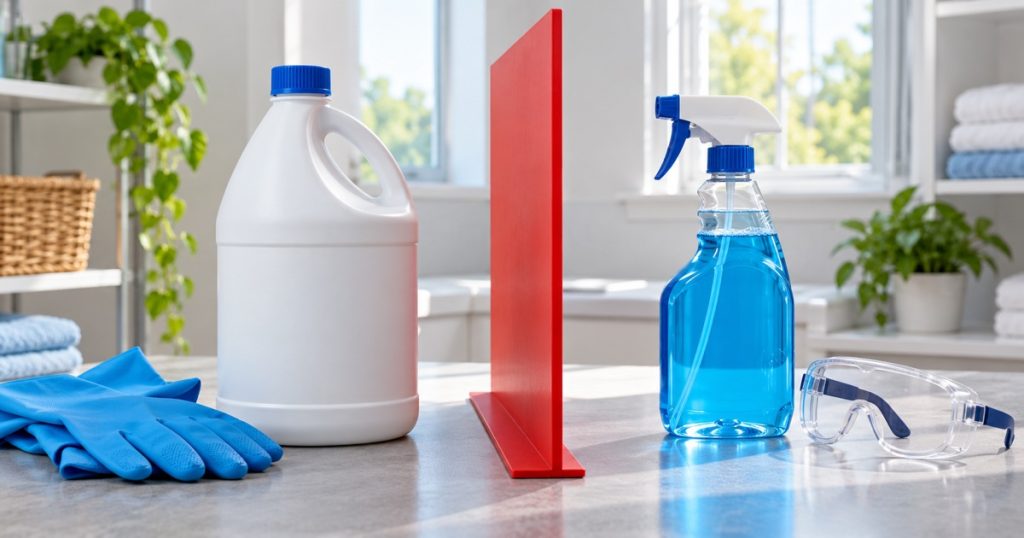
Ammonia may appear in some glass, floor, and multipurpose cleaners, but the product category alone does not tell you what is inside. Check the exact label before cleaning near a bleach-treated surface.
How to recognize the ingredients
These are illustrative label clues, not labels from a tested product:
- “Sodium hypochlorite”: a common ingredient in household chlorine bleach.
- “Ammonia,” “ammonium hydroxide,” or “ammonia solution”: wording to look for in the other product’s ingredient information or SDS.
- “Ammonia-free”: not permission to add bleach. Other ingredients may still be incompatible.
Do not infer compatibility from a scent, bottle color, or a fragment of a chemical name. If the bottle is unmarked, set it aside rather than testing it by smell or mixing.
A common mistake: the same cloth or bucket
You clean a mirror with an ammonia-containing spray, then use the still-wet cloth with a bleach bathroom cleaner. Although the bottles were never poured together, their residues can meet on the cloth or surface.
Before starting: choose one label-appropriate product for each task, keep products in original containers, and do not use a cloth or container holding another cleaner. If changing products is necessary, follow the exact labels for rinsing and use; an assumed drying time is not a compatibility check. Ask the manufacturer when the sequence is unclear.
What happens chemically?
Bleach can react with ammonia to produce chloramines. In an uncontrolled household mixture, released gases can irritate or injure the eyes and respiratory tract. Washington State Department of Health warns of coughing, nausea, watery eyes, wheezing, chest pain, and shortness of breath.
The products, amounts, and room conditions affect exposure. A “small amount,” an open window, or the absence of an obvious smell cannot establish that a mixture is safe. Do not experiment with proportions.
Is this chlorine gas, chloramine, or mustard gas?
These names are not interchangeable. The characteristic hazard from bleach plus ammonia is chloramine gas; bleach plus an acidic cleaner can release chlorine gas. Poison Control explains these household-fume hazards. Sulfur mustard, often called mustard gas, is a different chemical warfare agent described by the CDC; it is not another name for chloramine.
Correcting the name does not make a household mixture harmless. A mixed product can contain more than one hazardous substance, and neither the odor nor an online description identifies the exposure. Leave fumes and get advice; do not try to distinguish gases yourself.
What about urine or a litter box?
Do not pour bleach onto urine or use it to improvise a treatment for pet mess. Nitrogen-containing material can react with bleach, and Poison Control specifically warns against combining bleach with urine. Choose a label-directed method suitable for the waste and surface. If another cleaner was already used, identify it before changing products. This precaution is not a claim that every trace of urine produces the same exposure; it is a reason not to experiment.
If it has already happened
Leave fumes first. Do not stay to rinse a bucket, neutralize the liquid, or retrieve bottles. Keep others away and obtain situation-specific poison or emergency advice. Use the accidental-mixing action guide for eye or skin first aid and a checklist for the call. Do not delay getting help to identify the exact gas.
Two questions worth checking
Does every glass cleaner contain ammonia?
No. Formulas vary, including within a brand. Read the exact product’s ingredient information and warnings. Regardless of its ammonia content, do not combine a glass cleaner with bleach.
Where should I look if the label is incomplete?
Find the manufacturer’s SDS for the exact product: Section 1 confirms identity, Section 3 describes reportable ingredients, and Section 10 describes reactivity and incompatibilities. If you cannot confirm a suitable use, contact the manufacturer.
Next: Visit the before-you-clean checklist or the broader guide to combinations to avoid.