Evidence-based guide
Can You Mix Bleach and Toilet Bowl Cleaner?
Do not add bleach to toilet bowl cleaner. Acidic formulas can release chlorine gas on contact with bleach. Already mixed products? Leave the bathroom; do not add anything else.
Breathing trouble, collapse, seizure, or cannot wake? Call emergency services now (US: 911). For US poison advice: 1-800-222-1222. Elsewhere, use your local poison service.
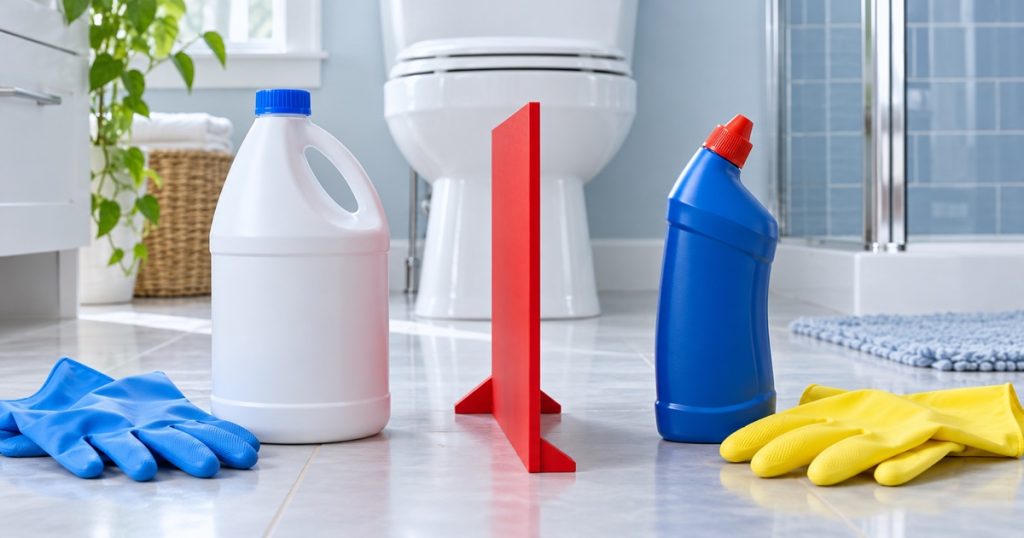
“Toilet bowl cleaner” describes a purpose, not a single chemical formula. Some products remove mineral deposits with acids; others contain bleach or different active ingredients. Do not decide compatibility from the words “bathroom,” “disinfecting,” or “with bleach.”
Three label situations to recognize
These are illustrative ingredient clues, not a comparison of tested brands:
- Hydrochloric acid or another acid: an acid-based cleaner must not contact bleach. Some mineral-scale and rust-removal products are acidic.
- Sodium hypochlorite: the product itself is bleach-based. That is not a reason to add another cleaner—or extra bleach.
- Ingredient unclear: a color, scent, “natural” claim, or product category cannot prove compatibility. Use the exact label and manufacturer information.
Washington State Department of Health explains that mixing bleach with acids can release chlorine gas and identifies some toilet bowl cleaners as acid-containing products.
Two real US product documents: acid versus bleach
These examples show how to read manufacturer information. They are not buying recommendations or results of our own product testing. Documents checked October 19, 2026; formulas and regional versions can change, so match the label on your bottle.
LYSOL Power Toilet Bowl Cleaner Clinging Gel
The US official SmartLabel entry identifies hydrochloric acid as the active ingredient. It includes the 24 fl oz bottle with UPC 0-19200-02522-5. Its use instructions prohibit combining it with chlorine bleach or other chemical products and restrict it to toilet bowls. The page states that its information was last updated June 27, 2023. Do not transfer this information to every product carrying the LYSOL brand.
CloroxPro Clorox Toilet Bowl Cleaner with Bleach
The manufacturer’s US SDS listing, identifier USA001475, links to a document issued May 28, 2021. Section 3 lists sodium hypochlorite. Section 15 reproduces a warning against use or mixing with other household chemicals, including other toilet cleaners, acids, and ammonia-containing products. This is evidence about the named formulation, not a compatibility certificate.
Why “with bleach” does not mean “add bleach”
A finished bleach-containing cleaner is a manufactured formulation with its own directions. Adding bleach to a different toilet cleaner changes that formulation and may create a hazardous reaction. Compare the full product name, market, identifier, and ingredient information—not just the logo or front-label claim. The two products above illustrate why the same cleaning task can involve very different chemistry.
Check the bowl, tank, and previous product
Before adding any cleaner, check whether an in-tank tablet, rim block, automatic dispenser, or earlier liquid treatment is already present. These products have different formulations; the visible bottle may not be the only source of chemicals.
If you do not know what is present, stop and consult the relevant product manufacturer. Do not pour in a second cleaner to improve stain removal. A blue color is not an ingredient test, and clear water is not proof that residues are absent.
Can I just flush between products?
Do not use a universal “one flush” or waiting-time rule. Toilet design, an active dispenser, and remaining residues can change the situation. Before changing products during normal cleaning, follow both labels and ask the manufacturer when the sequence is unclear.
If products have already mixed and fumes are present, leave. Do not stay in the bathroom to flush, scrub, dilute, or neutralize the mixture. Re-entry and cleanup need incident-specific professional guidance.
Choose the task before the cleaner
- Routine dirt: choose a single product labeled for the toilet surface and follow its directions.
- Mineral scale: choose a suitable scale-removal product only after resolving incompatible products or residues; do not add acid to bleach.
- Disinfection: use one labeled disinfectant at its stated concentration and wet-contact time. Adding another cleaner does not improve the tested directions.
Read how pH relates to cleaning for the difference between removing scale and removing other soils. pH alone is not a mixing-safety test.
What if someone has been exposed?
Follow the urgent instructions above and the accidental-mixing action guide. Do not wait for a precise gas identification or collect containers from a contaminated room. A poison specialist needs the products and symptoms you already know, not a completed chemistry analysis.
Next: Use the before-you-clean checklist and the overview of combinations to avoid.