Evidence-based guide
How to Read a Hegman Gauge for Paint
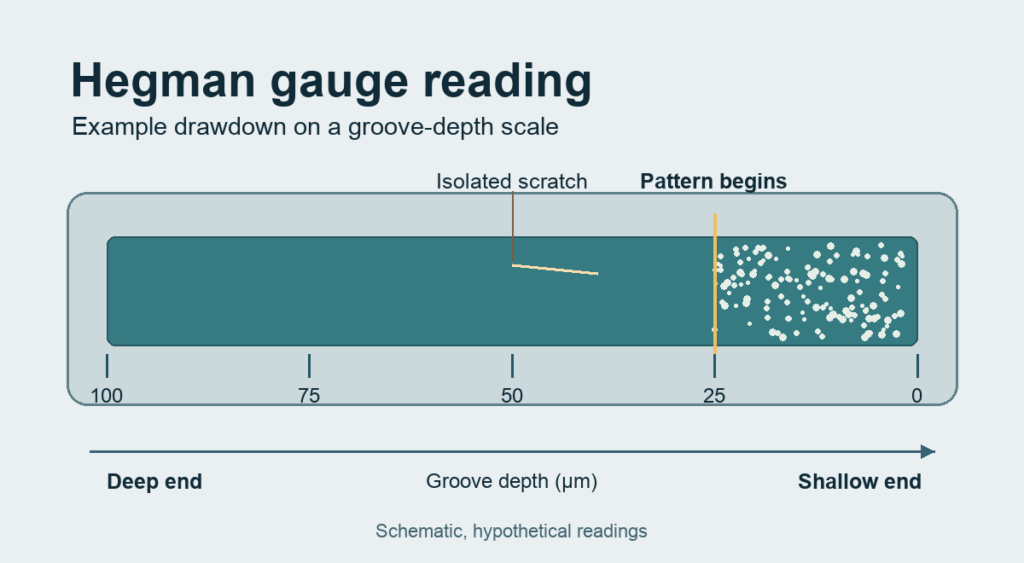
On a Hegman gauge, read the mark beside the start of the repeated particle pattern in the wet drawdown. Your test method defines which pattern counts. Write down the reading and its scale. If a lone scratch appears closer to the deep end, record it separately so the next person can tell what you saw.
Read the groove depth
The scraper spreads a wet sample from the deep end of the groove toward the shallow end. As the film gets thinner, coarse particles or clusters come into view. A mark in micrometers gives the groove depth at that spot. On the Hegman scale, the numbers run the other way. They rise as the groove gets shallower.
ASTM D1210 covers this check for liquid coatings and their intermediates. The method also allows a separate cleanliness or texture rating for particulates. Write down where you took the sample, especially if you’re comparing a mill sample with one from a finished container. The guide to pigment dispersion in paint explains what happens to clusters during mixing.
What to do with a stray scratch
Inspect the groove under the viewing conditions and within the time specified by your method. A bubble or a gap left by the scraper can make the edge of the pattern hard to place. If you can’t read it, note what obscured it and make a fresh pull on a clean gauge with a clean scraper.
Imagine a lab accepts readings of 25 µm or less and requires two agreeing valid pulls. Both the limit and the readings below are hypothetical.
| What you see | What you record |
|---|---|
| One scratch near 50 µm and a clear particle pattern at 25 µm. | Record the scratch separately. Repeat according to the lab’s rule before reporting. |
| Two valid pulls show the qualifying pattern at 25 µm. | Record both readings. They meet the lab’s inclusive limit in this example. |
| One valid pattern at 25 µm and another at 50 µm. | Hold the decision and follow the repeat procedure. Keep both readings so the disagreement is visible. |
Compare results from two labs
Keep the batch ID, sampling point and preparation with the reading. Record the method edition and the scale and range of the gauge, then list the individual pulls and any unusual marks. Ask the other lab for the same details. Even when both reports use micrometers, the labs may have used different criteria to identify the pattern. For example, ISO 1524:2020 calls for a micrometer-graduated gauge and excludes products containing flake pigments.
A gauge reading records the depth where coarse material becomes visible under the test conditions. If the report also lists Dv50, use the particle-size guide to interpret that distribution statistic. The pigment chemistry guide covers other properties to ask about when comparing coatings.