Evidence-based guide
Paint Gloss Measurement: How to Read GU and Test Angles
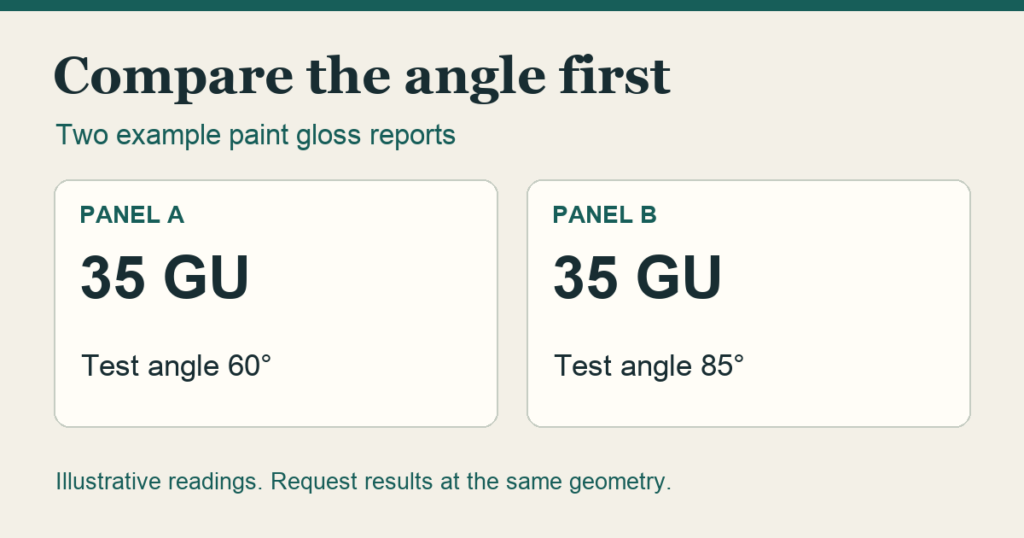
A paint gloss test measures how strongly a dried coating reflects light in the mirror direction under a defined setup. A useful result gives the reading in gloss units (GU) and the measurement angle together. If two reports give you the same number at different angles, ask for readings taken under the same method and geometry before deciding which finish is glossier.
Read the angle and the number together
A glossmeter directs light at the surface and collects it around the direction where a mirror would send it. The instrument compares that response with a reference scale. The public summary of ASTM D523 describes a black glass reference and lists 20°, 60°, and 85° geometries for nonmetallic specimens. If a report gives a value of 40 GU, that value is on the gloss scale. It does not tell you that the surface reflects 40 percent of all the light that reaches it.
Before accepting a result from a finished part, ask where the instrument was placed and which method and edition the lab followed. A broad, flat panel and a narrow rounded edge give the instrument different surfaces to sit on. If your requirement applies to a flat witness panel, record which part that panel represents and keep any reading from a curved part in a separate row.
What to do with two supplier reports
Imagine two finish samples arrive with these labels. The numbers are hypothetical.
| Label on the report | What you can use | What to request |
|---|---|---|
| Panel A: 35 GU at 60° | The scale and geometry are stated. | The test method, panel preparation, and age when measured. |
| Panel B: 35 GU at 85° | The scale is stated, but the geometry differs from Panel A. | A result at the geometry specified for your comparison, using comparable preparation. |
Do not average the two numbers or try to convert one using the angle alone. If your specification says to use 60°, ask for results at that geometry and check that both specimens are suitable for the method. If the specification only says “satin,” agree on a test method, a geometry, and an acceptance range before interpreting the reports.
Keep the preparation with the result
For a comparison panel, keep the specimen ID, support, preparation method, film thickness if known, time since application, and measurement locations with the readings. Also record the standard and edition, instrument, geometry, and reference check. Follow the chosen method for calibration, drying or conditioning, and the number and location of measurements. If a panel looks streaky, keep the individual readings and their positions so the average does not hide a patchy finish.
Check whether gloss is the property you need
If the substrate shows through, check paint hiding power. That comparison asks how well a film obscures what lies beneath it. If two panels match under one lamp and differ under another, consider the lighting changes described in the guide to illuminant metamerism. Reduce distracting glare when comparing their color, and record gloss separately if the shine itself matters to the specification.
When a gloss report is your only evidence, use it to answer the narrower question it actually measured: how much light the coating returned near the mirror direction at the stated geometry. The pigment chemistry guide connects that comparison with other paint properties, including color and opacity.