Evidence-based guide
Titanium White vs Zinc White: Coverage, Mixing and Oil Paint
Titanium white and zinc white are different white pigments: titanium dioxide is PW6; zinc oxide is PW4. Titanium white generally hides a dark background more strongly. Zinc white can leave more of the underlying color visible, depending on the paint and its thickness. For oil painting, appearance is only part of the comparison: zinc-containing oil paints have documented problems with brittleness and separation of paint layers. Those findings do not establish the same behavior in acrylic or watercolor paint.
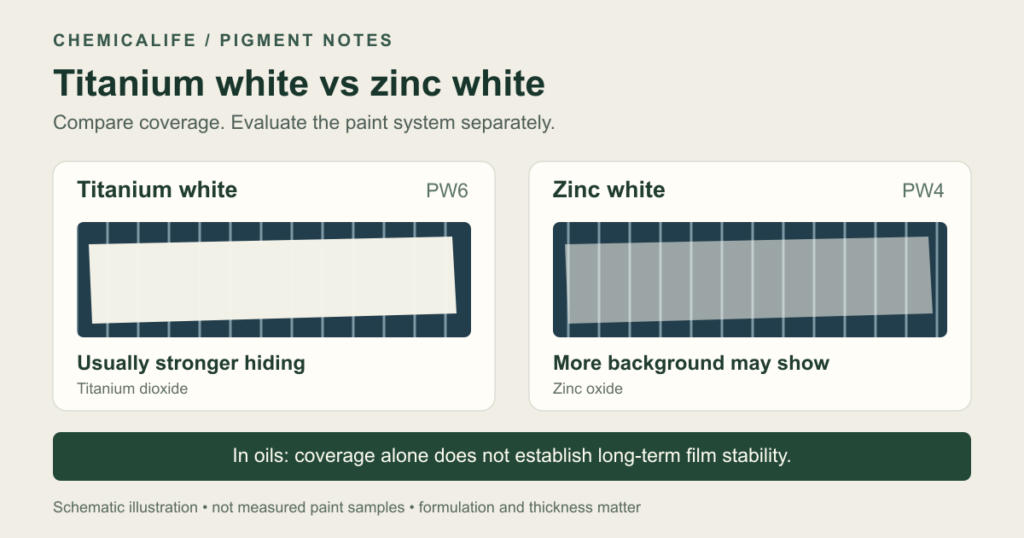
Imagine painting a pale cloud over a dark blue sky. One white quickly obscures the blue; another leaves a softer, more translucent patch. That difference may be useful, but it tells you nothing by itself about how the paint will age. When comparing titanium white vs zinc white, separate three questions: what is in the tube, what happens on the palette, and what happens in the dried film.
Start with PW6 and PW4, not just the color name
The Museum of Fine Arts Boston’s CAMEO database identifies titanium white as Pigment White 6 and zinc white as Pigment White 4. Look for those codes in the pigment information supplied with the paint.
A tube labeled “Titanium White” is not necessarily a single-pigment paint. CAMEO notes that artists’ titanium whites may include zinc white and fillers. A label listing PW6 and PW4 therefore deserves a different description from one listing only PW6. The codes identify pigments; they do not tell you the proportions or the full binder and additive recipe.
| Question | Titanium white | Zinc white |
|---|---|---|
| Which pigment? | Titanium dioxide, TiO2; PW6. | Zinc oxide, ZnO; PW4. |
| What is the usual coverage difference? | Stronger hiding of the background. | Usually lower hiding than titanium white in comparable paint films; not transparent under every condition. |
| What should a mixing test record? | How much the chosen paint lightens a fixed amount of color. | The same observation, using the same color and mixing method. |
| What needs special attention in oils? | The complete formulation, including whether zinc is also present. | Evidence of zinc-related changes in the aging oil paint film. |
The Fitzwilliam Museum’s pigment glossary describes titanium white’s greater hiding power and explains zinc white’s use in modifying colored mixtures. Treat that as a useful material comparison, not a guarantee that two unrelated finished paints will behave in a fixed ratio.
Hiding power and tinting strength answer different questions
Hiding asks how effectively a film conceals what is behind it. Tinting asks how strongly a paint changes the appearance of a mixture. A white stroke over a black line tests a different thing from a small addition of white to blue paint.
For the cloud example, drawdown samples over a contrasting background help answer whether the dark sky will show through. Our guide to paint hiding power explains why film thickness and background matter. For a general explanation of the white pigment’s optical role, see titanium dioxide in paint.
Then make separate mixing samples. Start with two equal portions of the same colored paint and add measured amounts of each white in the same way. Record the amounts and compare the dried results together. This is a comparison of those finished paints, not a measurement of the intrinsic strength of pure PW6 and PW4.
Do not turn the result into a universal “ten times stronger” rule. Different pigment concentrations, binders, and other ingredients make that shortcut unreliable across products. The tinting strength guide explains why a comparison needs a reference and consistent test conditions.
Why zinc white requires a separate discussion in oil paint
Drying oil is a reactive binder. Zinc oxide can interact with fatty acids in that binder to form zinc carboxylates, often called zinc soaps. These are reaction products within the paint, not evidence that someone cleaned the painting with soap.
In a Smithsonian and NIST study of an oil-paint test panel, researchers examined protrusions that developed after accelerated and natural aging. Their analysis traced zinc carboxylates within gel-like material in the paint. The study connects a chemical process to a visible defect; it does not predict when a particular tube of paint will fail.
Conservation research on zinc oxide and drying oils has also associated zinc-containing oil paint with brittle films and delamination, meaning separation between layers. The useful question is therefore more specific than “Is zinc white good or bad?” Ask whether the proposed oil-paint system has evidence supporting the intended support, ground, layer arrangement, and aging behavior.
A pleasant mixing feel or an attractive dry swatch cannot settle those long-term questions. Nor does a low zinc content printed somewhere establish a universally safe percentage. Avoid treating one ingredient as a lifetime guarantee in either direction.
Does choosing titanium white remove every durability concern?
No. Research on the formulation of titanium-white oil paints found that the TiO2 type and combinations of ingredients affected degradation of the oil binder under the study conditions. That is why “contains titanium dioxide” is not a complete durability specification.
Keep the questions practical: Is the paint oil, acrylic, or watercolor? Which pigments are listed? Is it intended for the support and application you have in mind? What information is available about the finished paint, rather than just the pigment powder?
What changes for acrylic and watercolor?
The pigment identities remain PW6 and PW4, but the binder changes. Evidence about zinc reactions in drying oil should not be presented as proof that a zinc-containing acrylic or watercolor paint will develop the same defect.
For those media, begin with the optical comparison and the product’s own technical information. Compare dried films made in the same medium. Mixing an oil-paint result, a watercolor wash, and an acrylic swatch into one ranking would answer no clear question.
A short comparison record you can actually use
- Identify: paint medium, pigment codes, product and batch, and whether it is a blend.
- Compare coverage: same background, similar application thickness, and the same drying conditions.
- Compare mixtures: same colored paint, recorded additions, and dried samples viewed together.
- Ask about aging separately: the optical test cannot verify long-term film stability.
For a covering white, titanium white is a sensible optical starting point. For a subtler change in a mixture, judge the actual paints with a small comparison rather than relying on the name alone. If you work in oils, include the zinc question before settling on the paint system. The pigment chemistry guide connects these choices with the other properties that shape a finished paint.