Evidence-based guide
What Is Masstone? Reading a Paint Color Before Mixing
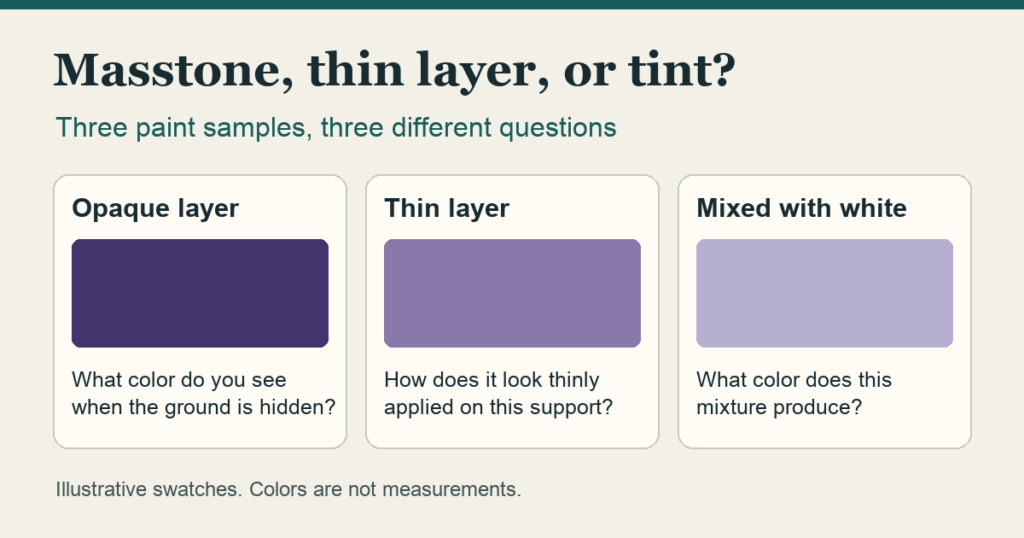
Masstone is the color of a pigment viewed in bulk or in a paint layer thick enough to hide what is underneath. It tells you how the material looks in that condition. It does not tell you everything about a thin application or a mixture with white. When comparing paints, label those three samples separately instead of treating them as interchangeable color chips.
What does masstone mean?
The Getty Research Institute lists masstone and mass tone as names for mass color. Its definition covers pigment seen as a powder heap or incorporated into a medium and applied as an opaque, substantial layer.
For a paint comparison, the useful detail is the sample condition. A label saying “blue” identifies a broad color family; a label saying “masstone” tells you something about how the color was presented. Neither label identifies a pigment formula, a mixing ratio or a durability rating.
Give each sample its own question
Suppose you are making a reference card for two paints already in your studio. Before applying them, divide the card into three labeled areas. This is a suggested record-keeping exercise, not a standardized measurement method.
| Sample | Question to record | What to keep separate |
|---|---|---|
| Opaque, substantial application | How does this paint look when the ground is hidden? | Do not use the result alone to predict a thin application. |
| Thin application | How does the paint look when applied thinly on this support? | Record the ground and any added medium. |
| Mixture with white | What color does this particular mixture produce? | Record the white paint, proportions and measuring basis. |
The middle sample is often discussed using the term undertone in artists’ paint literature. For your own records, a concrete description such as “thin application over white card, no added medium” is more informative than the word alone. A white mixture deserves a separate label because you have changed the composition of the paint, not just its application.
A sample card that another person can interpret
Imagine that two unlabeled cards are left on a workbench. One has a dark patch and a pale streak; the other has three blue patches. Without preparation notes, a second person cannot know whether the pale area contains white paint, was spread more thinly, or belongs to another material. More patches have not necessarily produced more useful information.
Make a simple label for each paint and write it before you start. For instance, the card could say “Paint A, white primed panel, dried overnight.” Under the thick patch, note whether the ground is still visible. Under the thin patch, record the support and whether you added medium. A white mixture could be labeled “1 g Paint A plus 4 g White W,” if those are the amounts you actually weighed. Treat those numbers as an example of a label, not a recommended recipe.
Then record one observation for each pair at the same stage of drying and in the same light. If the thick patches look alike but the thin patches differ, write both observations. Someone repeating the comparison can then prepare the same kinds of samples and see whether the difference persists.
Masstone is not a tinting-strength result
A reference card may help you decide which mixture to investigate next. To compare tinting strength, however, you need a defined comparison of mixtures. Record what was mixed and how much. A photograph of two unmixed piles does not provide that information.
Likewise, a masstone sample does not establish how much paint you need to cover a wall. The sample may have been applied much more thickly than the intended coating. A hiding-power comparison asks about background visibility under specified application conditions. Keep that question separate from the color you see in a thick sample.
Choose the patch that matches the job
If your next step is a white mixture, start by comparing documented white mixtures. If you plan a thin application, make a sample on the intended support. Keep the masstone patch as another reference, with its preparation notes attached.
Before filing the card, check that someone else could identify every patch without asking you how it was made. That small habit makes the card more useful than a row of attractive but unexplained colors. For the broader relationship between color, opacity and other pigment properties, see the pigment chemistry guide.