Evidence-based guide
Oil Absorption of Pigments: How to Read and Compare the Numbers
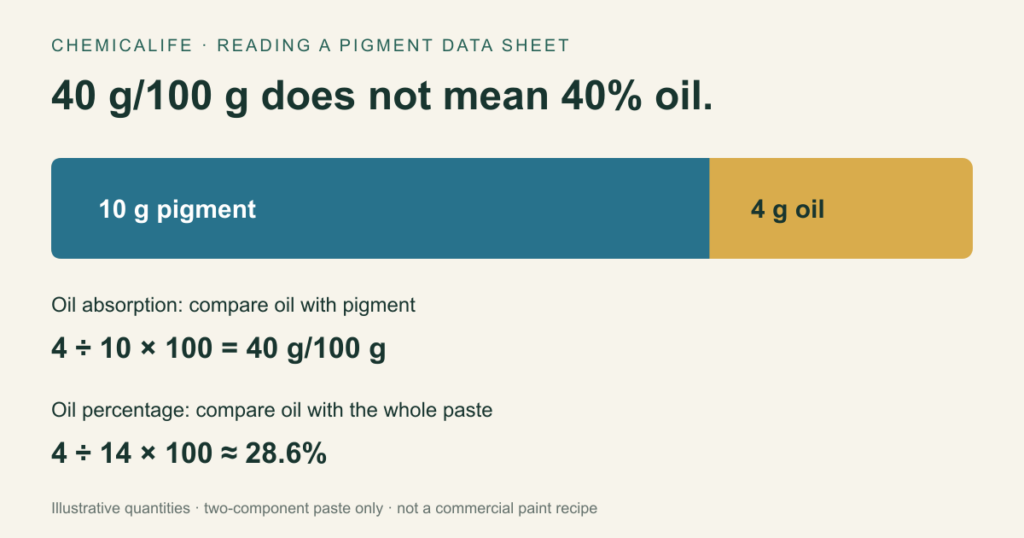
Oil absorption of pigments is a test value describing how much oil a pigment sample needs to reach a defined paste endpoint. Read the unit and test method alongside the number. A value of 40 g/100 g means 40 grams of oil per 100 grams of pigment under those test conditions; it does not mean that a finished paint contains 40% oil.
You are comparing two pigment data sheets. One lists oil absorption as 25; the other says 40. It is tempting to choose the lower figure and expect an easier paint formulation. Before making that choice, find the missing information: 25 of what, measured how, and for which grade? Without those details, the two numbers may not be comparable.
What the oil absorption value tells you
The value is useful as an indication of a pigment’s demand for liquid vehicle in a paste. It can also help characterize different batches. The public description of ASTM D281 gives those uses for its spatula rub-out method.
This is a defined material test rather than a full paint recipe. A finished coating also has a binder system, processing conditions, and performance targets. Knowing the oil demand does not tell you whether that coating will dry properly, adhere well, or provide the desired finish.
How to read g/100 g and mL/100 g
Some reports use the mass of oil; others use its volume. ISO’s oil absorption terminology allows both mass-to-mass and volume-to-mass reporting. Always copy the complete unit into your comparison notes.
| Data-sheet entry | How to read it | Before comparing |
|---|---|---|
| 40 g/100 g | 40 g of test oil for each 100 g of pigment. | Check the method and specified oil. |
| 40 mL/100 g | 40 mL of test oil for each 100 g of pigment. | Do not treat milliliters as grams. |
| 40, with no unit | The number alone is incomplete. | Request the unit before ranking the grades. |
If a conversion is necessary, use the density of the specified test oil at the relevant temperature. For example, a hypothetical oil density of 0.93 g/mL converts 40 mL into 37.2 g. That arithmetic does not make results from different test procedures equivalent.
A worked calculation: why 40 is not 40%
Suppose a fictional test uses 4 g of oil with 10 g of pigment to reach its endpoint. Expressing the ratio per 100 g of pigment gives:
Oil absorption = (4 ÷ 10) × 100 = 40 g/100 g.
The denominator is the pigment mass. If you instead ask what fraction of this two-component paste is oil, the denominator changes to the total paste mass:
Oil fraction = 4 ÷ (10 + 4) × 100 ≈ 28.6% by mass.
These are two different questions about the same illustrative quantities. Neither calculation establishes the oil percentage in a commercial tube of paint. Fillers, other ingredients, and the manufacturer’s formulation would need to be accounted for.
For a real data-sheet example, NAGASE lists Vibrantz EC-62 ultramarine blue at 40 g/100 g using ASTM D281. That entry illustrates the unit and method together. It is not a value for every ultramarine blue grade, and it is not our own measurement or a product recommendation.
Why different pigments need different amounts of oil
The liquid interacts with particle surfaces and occupies spaces in the powder structure. Surface area, particle shape, packing, and surface treatment can therefore affect the result. A smaller particle size can increase surface area, but it also changes packing; particle size alone is not a reliable conversion rule for oil absorption.
Chapter 2, section 2.3.3 of Li Yuanyuan’s Pigment Chemistry and Technology discusses this distinction between surface demand and the spaces between particles. It helps explain why a pigment’s chemical name is not enough to predict its measured value. Our organic versus inorganic pigment guide explains what those family labels can and cannot establish.
Use the same method before judging a difference
ASTM D281 uses a rubbing action, while ASTM D1483 uses gentler stirring and folding. ASTM explicitly notes that their different endpoints generally produce different values. A higher result from one method cannot automatically be read as a worse batch than a lower result from the other.
ISO 787-5:2026 also describes comparison with an agreed reference sample tested at the same time. When requesting a comparison, include the method edition and ask whether the reference and candidate were tested together. A supplier’s typical data-sheet value and a batch acceptance limit serve different purposes; ask which one you have.
A short checklist for a pigment substitution
- Identify the actual grade. Record its supplier code as well as its pigment name.
- Match units and methods. Keep the oil type, test method, and reporting basis beside each result.
- Ask about variability. Find out whether the number is typical, a specification range, or a result for the supplied batch.
- Check the complete formulation. Use an agreed trial to evaluate processing and finished-film performance before treating the material as a replacement.
Low oil absorption is not a general quality score. It answers one part of the formulation problem. If your question is whether a paint will cover a dark background, look separately at hiding power. Return to the pigment chemistry guide to compare that property with color, durability, and the other decisions a pigment data sheet supports.