Evidence-based guide
What Are Pigments Used For? Paint, Plastics, Ink and More
Quick answer: Pigments are small solid particles used to color paint, printing ink, plastics, textiles, ceramics, and building materials. In paint, some pigments also help hide the surface underneath. Which pigment works best depends on the material, how it’s made, and what the finished product needs to do.
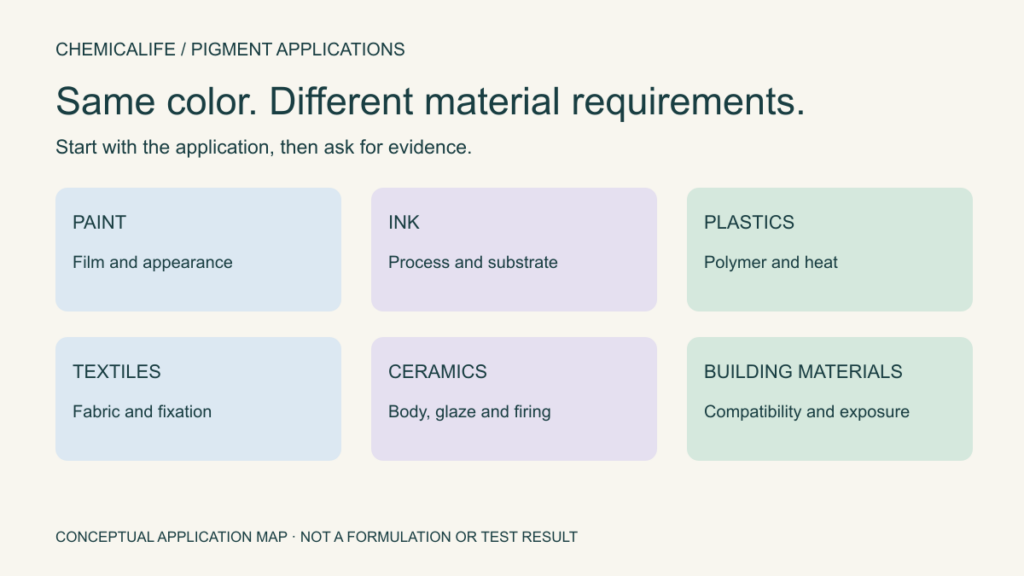
A blue wall, a blue plastic container, and a glazed tile can all match in color. In the wall paint, a binder holds the pigment in place as the coating dries. For the container, the manufacturer needs a pigment that works in the chosen plastic during molding. For the tile maker, the blue that counts is the one that comes out of the kiln.
Here we look at how manufacturers and artists choose pigments for the materials they work with. Biological pigments in skin, plants, and blood fall outside that scope.
What makes a colorant a pigment?
Follow the color into the material. In a pigment ink, tiny solid particles stay dispersed in the ink. In a dye ink, the colorant is typically dissolved. See how pigments and dyes differ in ink and fabric. Both inks may come out of a bottle looking blue; the difference is what the colorant does in that ink. A pigment can arrive as a liquid paste because someone has already dispersed the particles. It needn’t come as a dry powder.
Pigment particles can absorb some wavelengths of light and scatter light back toward your eye. How much light the finished layer lets through matters, too. An opaque white paint can cover a pencil line. A transparent watercolor can tint the paper and leave the line visible. Both can contain pigments.
Other solids in a can of paint have different jobs. A manufacturer might add an extender to change the texture or add bulk. Knowing the pigment tells you something about the color, but it won’t tell you how the whole paint will behave.
Egyptian blue: a pigment people made on purpose
Artists could get earth colors from ocher, but they also made colors that took more than digging and grinding. Egyptian blue is a calcium copper silicate pigment made by firing raw materials. Getty researchers identified it in Romano-Egyptian mummy portraits. It’s an early example of a synthetic pigment, centuries before modern paint factories.
That distinction still matters at an art store. “Synthetic” tells you someone made the pigment; it doesn’t tell you whether the compound is organic or inorganic. And a traditional color name on a tube can refer to a modern mixture. If you want to know whether two tubes contain the same pigment, compare the pigment names or codes on the labels.
Six common uses of pigments
| Material | Sample to look at |
|---|---|
| Paint | A dry coat over the color you need to cover |
| Printing ink | A proof on the paper you’ll print on |
| Plastic | A molded part in the intended resin |
| Printed fabric | A printed swatch after washing |
| Ceramics | A fired test tile with the chosen glaze |
| Colored concrete | A cured sample made with the proposed mix and finish |
Paint and hiding power
Suppose you’re repainting a dark wall pale blue. A color chip helps you choose the blue. To judge how well the paint will hide the old color, look at a dried sample over a dark background. An artist choosing a transparent blue wash wants the earlier brushwork to show through. If you’re choosing paint for an outdoor wall, check that the finished paint is intended for exterior use, too.
Ink on a label, pigment on a shirt
A package designer checking a blue logo needs a proof on the actual label stock. A proof on bright white paper answers a different question if the order will be printed on brown paper. For a printed shirt, the ink’s binder has to hold the pigment on the fabric through wear and washing. Handle a printed swatch as well as looking at it: a print can match the artwork and still feel too stiff for the shirt.
Plastic parts and glazed tiles
If you’re specifying a blue plastic container, ask for a color sample molded in the resin the factory will use. A chip made with another resin leaves a practical question unanswered: will you get that blue after your plastic goes through molding? A tile maker faces a different test. Lay a fired test tile beside the target color. Keep a record of the glaze and firing conditions so the tile is a useful reference for the next batch.
Color in concrete
A concrete paver can carry color through the mix rather than just in a coating on top. If you’re ordering pavers, compare cured samples. The color of the cement and the finish of the surface both affect what you see. A photograph of the dry pigment can’t show you how a textured paver will look beside the existing walkway.
Choosing between two products of the same color
Say you want to print a blue design on a cotton tote. Two fabric colors look right on screen. One comes with a color swatch; the other also names cotton, gives instructions for fixing the print, and explains how to wash it. You have a better starting point with the second product. Try it on a scrap of the same fabric, follow its instructions, then wash the scrap as you plan to wash the bag. Look for a change in color or loss of detail along the edges of the design.
For a less familiar material, put the question to the supplier in those same terms: “Have you tested this grade in the material I’m using? Can I see the finished sample or the result?” Two products can share a pigment but contain different amounts of it, use different binders, or produce layers of different thicknesses. A matching pigment code alone won’t settle the choice. Nor does a code on an artist’s paint establish suitability for food, cosmetics, or tattoos.
What does a standard on a data sheet actually tell you?
ISO 18451-1:2019 defines terms for pigments, dyestuffs, and extenders. It’s useful when a supplier and a buyer need to agree on what a word means. It gives no wash result for your tote. If a supplier cites a test method instead, ask what sample they tested, under what conditions, and what result they got. Then compare that result with what your product needs to do.
Sources
- Li Yuanyuan, 颜料化学与工艺学 (Pigment Chemistry and Technology), Chemical Industry Press, 2020, chapter 1, pp. 1–8. ISBN 978-7-122-36005-2. Background on pigment terminology, history, and uses.
- Color Pigment Manufacturers Association: Pigment FAQs. Industry definitions and common applications.
- Getty: Egyptian blue in Romano-Egyptian mummy portraits. Research behind the historical example.
- ISO 18451-1:2019: Terminology. Public catalog description of the standard’s scope.