Evidence-based guide
Lightfastness Explained: How to Read Paint Ratings
Quick answer: Lightfastness is resistance to color change under light exposure. A rating is meaningful only with its scale, test conditions and product context. It does not promise that a painting will never fade or that an artist’s color is suitable outdoors.
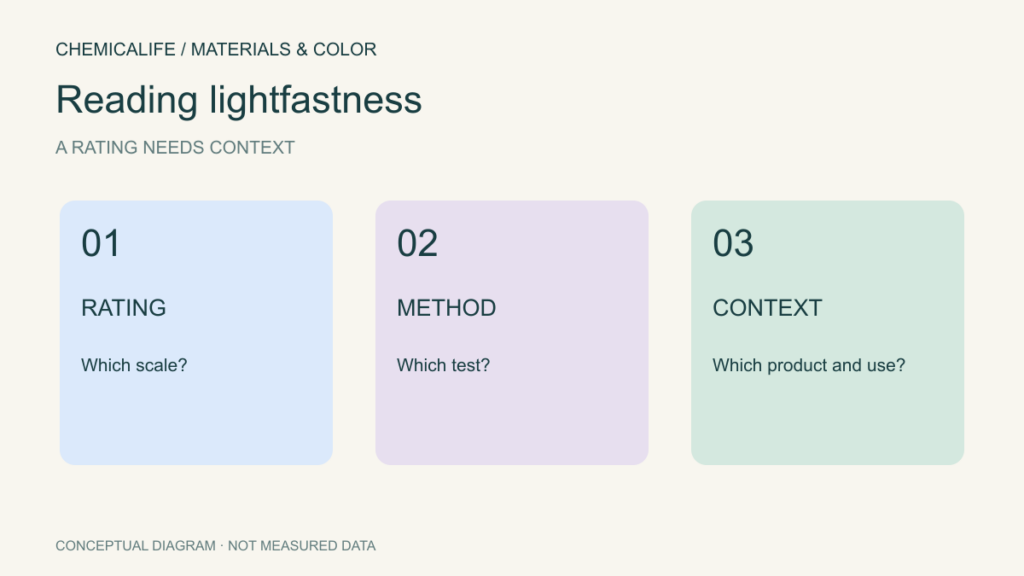
Start with the exact paint range and color. Similar color names from different manufacturers can contain different colorants or mixtures. Even when a pigment identity matches, the medium and how it is used still matter.
How to read a lightfastness label
- Find the rating legend. Roman numerals, letters and stars are not automatically interchangeable.
- Identify the method. Check whether the maker names an ASTM method, describes its own tests or uses supplier information.
- Match the product. Confirm the rating applies to this color in this range.
- Read qualifications. Look for conditions involving thin washes, tints or a protective treatment.
- Match the use. An indoor art-material rating does not cover every outdoor exposure.
Examples of rating systems
| System | Example meaning | Important limitation |
|---|---|---|
| ASTM-style lightfastness categories shown by GOLDEN | I: Excellent; II: Very Good | Use the named method and the exact color’s information |
| Winsor & Newton permanence letters | AA: Extremely Permanent; A: Permanent | Permanence includes more considerations than lightfastness alone |
| An unlisted or unavailable test rating | The particular standardized rating is not supplied | Do not interpret missing evidence as either poor performance or a guarantee |
GOLDEN’s label guide distinguishes ratings obtained under ASTM D5098 from ratings assigned using its own and pigment-supplier information. Its technical chart explains that test samples and controlled comparisons underpin the classifications. A rating should be read as evidence from a defined evaluation, not a literal countdown to when a picture will fade.
Lightfastness is not the same as permanence
A material can face more than light. Moisture, the support, binder changes and other environmental conditions can affect its appearance. Winsor & Newton’s permanence framework considers several factors and can include qualifications for particular uses. When comparing labels, first check whether both brands are even rating the same property.
And it is not the same as weather resistance
An outdoor coating encounters stresses beyond illumination. Do not choose an exterior wall finish from an artist-paint lightfastness label alone. Ask for product-specific exterior suitability and the coating system’s instructions. For artwork, use the manufacturer’s guidance for its intended display environment rather than borrowing a lifespan claim from a different material.
Why a tint or wash can need its own check
A full-strength sample and a pale application do not present color in the same way. The amount of colorant, the background and the medium affect the visible result. A qualification for a thin wash is therefore relevant if that is how you plan to work. Do not copy a favorable full-strength label into a blanket statement about every dilution or mixture.
A useful record for your materials
Keep a small reference entry with the brand, range, color name, pigment codes, rating, source URL and date checked. Add how you actually used it: full strength, mixed with white or in a wash. This makes later comparisons more useful and helps you distinguish a formulation change from an exposure difference.
If no appropriate rating is available, ask the manufacturer for the missing information. For a piece intended to be kept or displayed for a long time, a documented alternative is easier to assess than an unsupported “archival” claim.
Can I test it in a window?
A side-by-side exposed and protected sample can reveal a difference under your particular conditions. It cannot establish an ASTM category or a universal number of years. Glass, season, location, exposure duration and sample preparation vary. Label any such observation with those limitations; do not describe it as a standardized certification.
Does “excellent” mean zero change forever?
No. It describes performance within a rating system. It cannot remove the effects of every possible material combination or environment.
Does a higher price mean a better rating?
Price is not a substitute for test evidence. Compare the exact color’s data.
Explore the pigment chemistry guide for related explanations of color, opacity and durability.
Sources and editorial scope
- GOLDEN: Acrylic label information
- GOLDEN: Technical chart and lightfastness definitions
- Winsor & Newton: Terms explained
- Li Yuanyuan, 颜料化学与工艺学 (Pigment Chemistry and Technology), Chemical Industry Press, 2020. ISBN 978-7-122-36005-2. Background reading: Chapter 2, section 2.5.3, p. 16.