Evidence-based guide
Paint Hiding Power: Why Some Colors Need More Coats
Quick answer: Paint hiding power describes how effectively a coating obscures the surface below. It depends on the paint and the applied film. Strong color, a thick-feeling paint or a large coverage figure does not guarantee that one coat will hide a contrasting background.
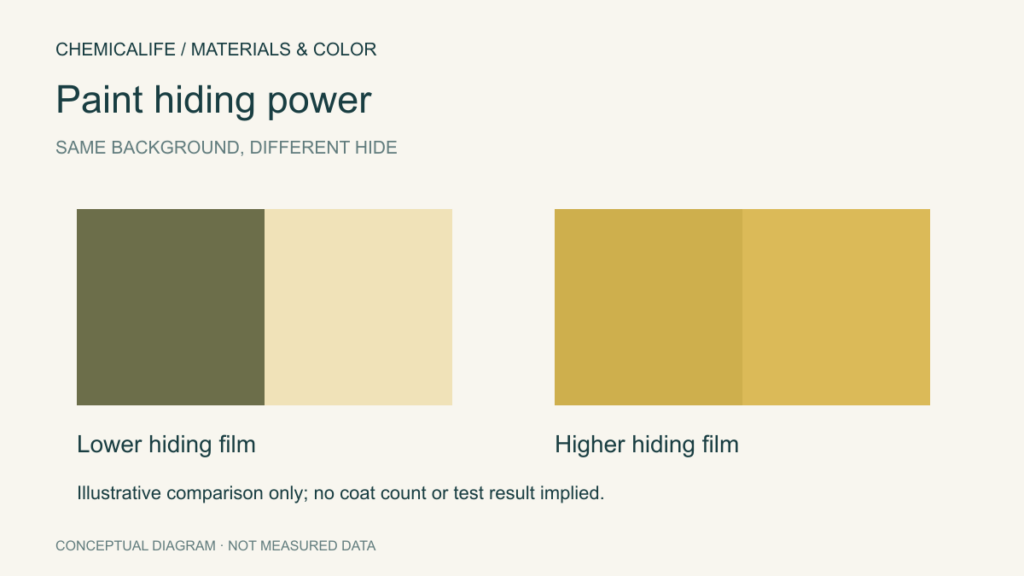
Judge hiding after the coating has dried as directed. The appearance of wet paint can differ from the finished film. If the old color remains visible, first separate an optical hiding problem from other issues such as uneven texture, staining or an incompatible surface.
Hiding power, tinting strength and coverage are different
| Term | What you are asking | Useful comparison |
|---|---|---|
| Hiding power | Does the background remain visible? | Dry films on the same contrasting background |
| Tinting strength | How strongly does the color change a mixture? | Equal additions to the same white or base |
| Spreading rate | How much area does a quantity coat at a specified thickness? | The manufacturer’s stated area, film build and conditions |
A strongly tinting blue can change a white mixture with a small addition while still making a transparent thin layer on its own. Likewise, spreading a can over more area makes the film thinner; it does not create more hiding material. Read what a coverage statement actually promises and under which conditions.
How the film hides a background
Light can be absorbed and scattered as it passes through a coating. If too much information about the underlying surface still reaches the viewer, the film looks insufficiently hiding. Pigment properties, the surrounding binder and the distance light travels through the film all contribute.
Particle size and dispersion matter, but “smaller is always better” is not a reliable rule. A formulation has to balance optical behavior and usable film properties. Stirring a finished paint as directed is different from industrial pigment dispersion; adding powder at home does not reproduce a designed formulation.
Check these causes before adding another coat
| Observation | What to check | Next decision |
|---|---|---|
| Broad, even show-through | Application rate and large color contrast | Check the specified film build and primer recommendation |
| Patchy coverage over repairs | Uneven porosity or preparation | Check whether the surface needs the specified primer |
| Roller tracks or uneven film | Applicator and application technique | Use the recommended tool and application method |
| A stain reappears | Possibly a stain-control problem, not only opacity | Ask for a compatible stain-blocking system |
| Paint was thinned | Whether thinning was permitted and at what limit | Return to the product’s technical directions |
Sherwin-Williams identifies thin films, porous surfaces, unsuitable applicators, thinning and strong color changes among causes of poor hiding. Its advice emphasizes the specified film build, suitable priming and drying before recoating. The right action still depends on the exact coating and substrate.
A fair sample comparison
- Use comparable prepared test areas rather than different walls with unknown histories.
- Record the product, color, primer and applicator.
- Apply each product at its recommended rate; do not deliberately overload one sample.
- Allow the stated drying time before comparing under the same light.
- Record how many permitted coats achieve the required appearance and how much material was used.
This is a practical observation, not a standardized laboratory rating. ASTM D2805 describes an instrumental reflectometry method with a defined scope. A photograph of a home sample is not evidence that a product passed that standard.
Common questions
Will adding white improve hiding?
It can change both opacity and color, depending on the products and proportions. For a finished wall paint, use the manufacturer’s tinting system rather than adding an arbitrary white or pigment. For artist mixtures, record your proportions and test the dry result.
Should I apply one very thick coat?
Follow the recommended film thickness and recoat schedule. A heavy coat is not a substitute for the specified coating system.
Does every color need the same number of coats?
No. Color, formulation, background and application conditions can differ. A successful result with one shade does not prove the same result with another.
Explore the pigment chemistry guide for related explanations of color, opacity and durability.
Sources and editorial scope
- Sherwin-Williams: How to fix poor hiding
- ASTM D2805: Hiding power of paints by reflectometry (public scope)
- Royal Talens: Opacity and transparency
- Li Yuanyuan, 颜料化学与工艺学 (Pigment Chemistry and Technology), Chemical Industry Press, 2020. ISBN 978-7-122-36005-2. Background reading: Chapter 2, section 2.2, pp. 11–12.