Evidence-based guide
Fluorescence vs Phosphorescence: Why Some Materials Keep Glowing
Quick answer: Fluorescence is usually prompt light emission following excitation; phosphorescence often persists longer. The familiar “lamp on versus lamp off” distinction is useful, but the scientific distinction concerns electronic transitions, so duration alone is not an absolute classification test.
A highlighter under suitable illumination and a glow-in-the-dark decoration may both look bright, yet their behavior after the light changes can be very different. First ask where the energy comes from and whether light is being reflected or emitted.
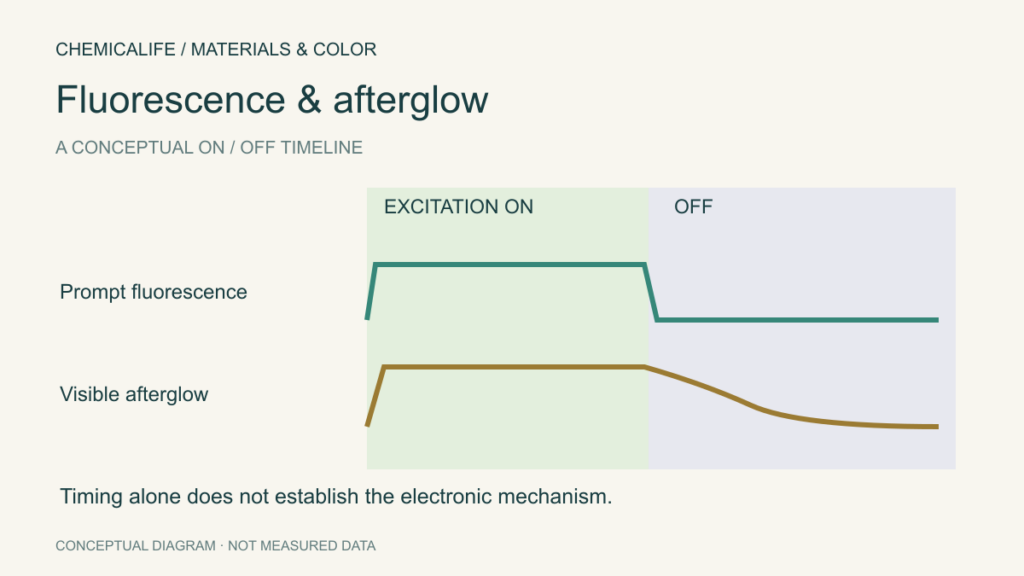
A simple on/off timeline
| Stage | Typical prompt fluorescence | A material showing afterglow |
|---|---|---|
| Suitable excitation light is on | Emits while being excited | Can take in energy and emit light |
| Excitation is removed | Emission falls away very quickly | Emission can remain visible and then diminish |
| After a longer interval | No sustained prompt emission without renewed excitation | Visibility depends on the material and conditions |
The diagram and table are qualitative. They do not specify brightness, decay time or charging instructions for any product. A very sensitive instrument may detect behavior that the eye misses.
What is fluorescence?
In the usual molecular picture, light excites a molecule and it releases some energy as emitted light through a transition that does not change spin multiplicity. Prompt fluorescence is typically very rapid. For everyday use, the practical question is whether the illumination can excite the particular material—not merely whether the lamp looks bright to you.
What is phosphorescence?
In the molecular definition, phosphorescence involves an emitting transition between states with different spin multiplicity. Such transitions are less readily allowed and often take longer. This explains the classic contrast with prompt fluorescence, but not every material sold as “glow-in-the-dark” can be fully described by one simple molecular diagram.
Edinburgh Instruments explicitly notes limits to definitions based only on time. Delayed fluorescence is one reason that “it still glows” is not sufficient by itself to prove phosphorescence. For a technical identification, use the material’s documented mechanism and measurements.
Four effects that should not be confused
| Effect | Main idea | Question to ask |
|---|---|---|
| Reflection | Incoming light is redirected toward you | Is there an external light source illuminating it? |
| Fluorescence | The material emits light following suitable excitation | What excitation light does this material need? |
| Photoluminescent afterglow | Emission continues after prior light exposure | What conditions and decay data are specified? |
| Chemical glow stick | A chemical reaction supplies the energy | Is the product a chemical light source rather than light-charged material? |
Why a glow stick is a different example
The American Chemical Society explains that ordinary chemical light sticks obtain energy from a reaction, which transfers energy to a dye that emits light. They do not need to be “charged” in sunlight like a light-excited decoration. The source of energy and the emitting process are separate parts of the explanation. Do not cut open a glow stick to investigate it.
How to read a product claim
- Define the desired effect. Bright under a lamp and visible after the lamp is off are different requirements.
- Check excitation conditions. Use the maker’s specified light and exposure directions rather than guessing a charging time.
- Check how brightness is reported. Initial brightness and brightness after an elapsed interval answer different questions.
- Check the viewing conditions. A photograph made in darkness is not a measurement of visibility in a lit room.
- Check the intended application. A decorative effect is not evidence that a material meets a safety-sign or other performance requirement.
Common questions
Does fluorescent always mean UV-only?
No. Excitation depends on the material’s absorption. A particular product may be intended for a UV lamp, but fluorescence as a category is not restricted to a single lamp type.
Does every bright neon-colored paint glow after dark?
No. A color name does not establish afterglow. Look for explicit product information about emission after excitation ends.
Can I identify the mechanism with a phone photograph?
A photo can record appearance but not establish an electronic mechanism. Exposure settings also change how strong a glow appears. Treat a photo as an illustration unless the measurement method is documented.
Explore the pigment chemistry guide for related explanations of color, opacity and durability.